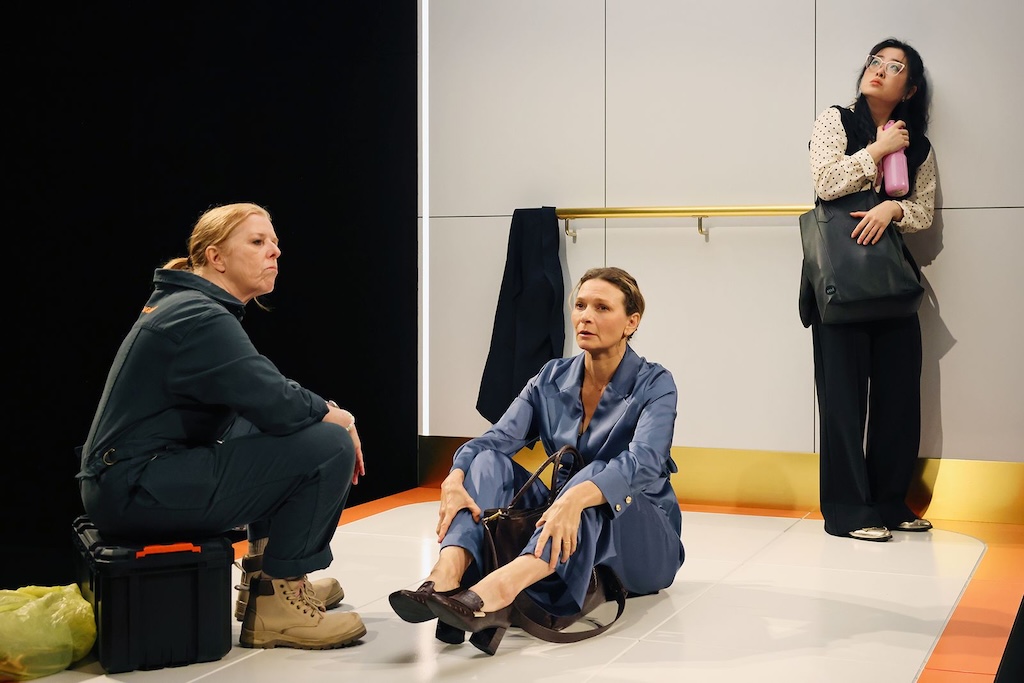
No exit: Di Adams, Leeanna Walsmann and Shirong Wu
Eloise Snape’s play The Elevator raises some interesting questions and does so – at times – with some very funny lines. She highlights the difficulties women face when trying to keep pace with big business (and big tech) empires and juggle family life. As the play’s director Anthea Williams writes:
‘Women are still expected to work as though they do not have people to care for, and to parent as though they do not have jobs. The strain created by these incompatible expectations is treated as a personal failure rather than the consequence of systems never designed to accommodate those who nurture. At the same time, work itself can be profoundly dehumanising, asking us to suppress our vulnerability, our responsibilities and, all too often, our consciences.’
True enough in most big workplaces. Snape airs these concerns through the characters of Margot (Leeanna Walsman), Alison (Shirong Wu) and Ollie (Di Adams), all of whom will find themselves trapped in malfunctioning lift.
CEO Mar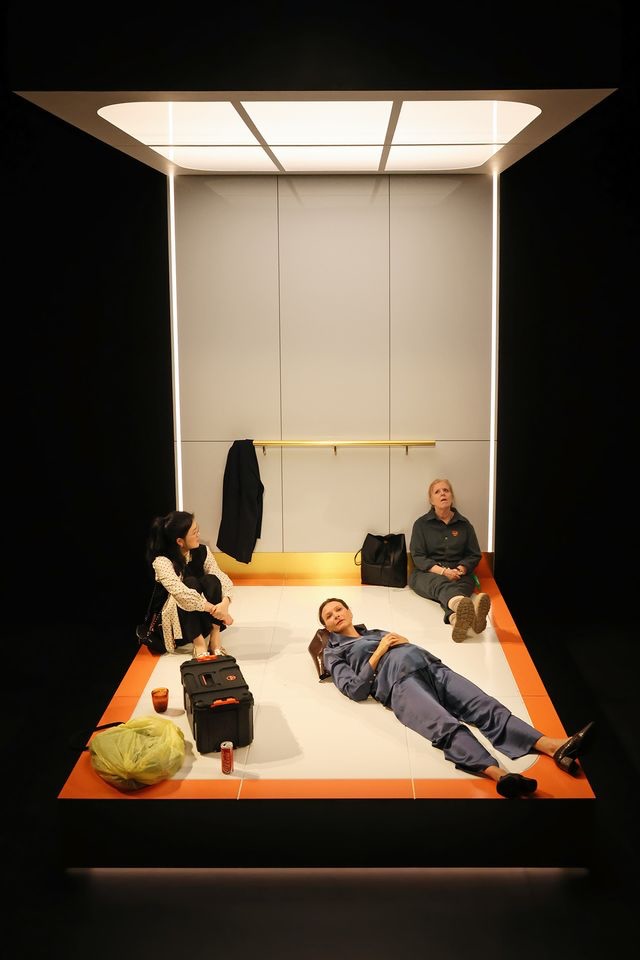 got, one day post-partum and whose newborn is in a hospital incubator, has returned to work and a PR disaster. One of Eco Engines driverless cars has gone rogue and run over a pedestrian. Stressed-out Margot takes out her frustrations on Alison, her flustered and put-upon subordinate. The press are waiting for a statement. Into the elevator, comes Ollie, one of the firm’s maintenance staff. The doors close; then the three are trapped together. Elevator, incubator, prison.
In the first half of this 90-minute play, Ollie is largely silent, listening to the PR spin and the tensions between Margot and Alison. There are some comedic, if cringe-worthy, moments in all of this – and Snape holds up a mirror to the corporate spin we are familiar with. Motherhood versus career; marketing versus truth; AI versus humanity and so forth.
Also, with AI so much in the news, it is laugh-worthy that the lift they are trapped in has no buttons or emergency phones – it relies instead on its AI TAURUS system, which isn’t working well, not very bullish at all; hence the trio’s imprisonment. Neither do their phones work. And the AI has decided to default to Italian. In the company’s driverless cars as well? Who knows?
It’s also fun that Ollie turns out to have been a London cabbie, with that encyclopaedic and undeniably human ‘knowledge’ of the city’s roads, yet is now employed by a company that sells driverless cars. When Adams’ voices Ollie’s rapid-fire run-down of a route from the city of London to a suburb in its southwest, it prompted a burst of applause (and for me, it was a journey I knew!).
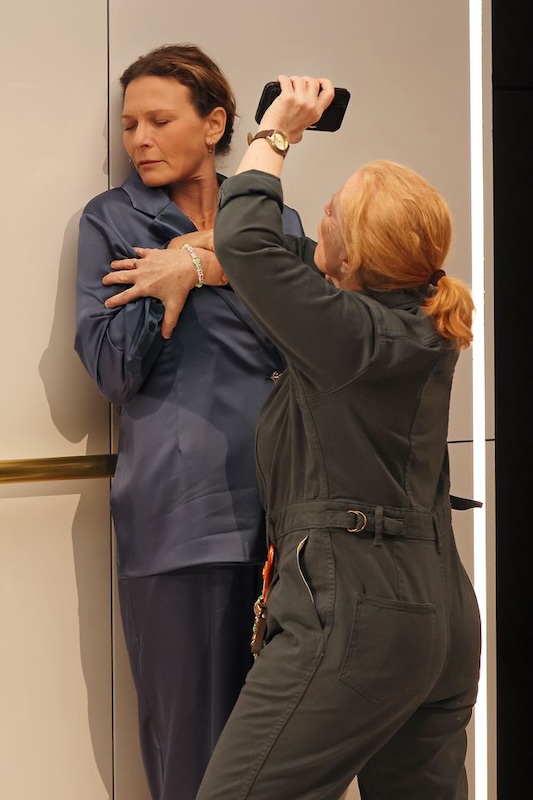 The acting is great: Walsman, Wu and Adams do a very fine job. Williams directs with pace. Snape’s script incorporates many ideas with much comedy. The problem for me is that the action slips too quickly from cynical comedy to full-on tragic horror, admittedly via the airing of a few ethical problems. Not that life can’t be like that, but the twist, when it comes, didn’t feel entirely plausible. The situation that Margo finds herself in, one day after giving birth, didn’t feel likely (stressed-out employee or not, who would do that?); Ollie’s revelations came too late and the denouement, though brutal, felt contrived. Alison, on the other hand, is an entirely relatable character, and Wu brought her own brand of comic acting to that role.
None of these comments are meant to deny that women’s place in the workplace remains inequitable; that would be a fantasy. Nor that the play doesn’t have some excellent moments. It’s also spot on that Walsman’s Margot has been brought in to clean up a previous (male) CEO’s mess. How many times have we seen that happen? Nor that when the pressure is on, people behave badly. Just that for me, by the end The Elevator, despite a trio of fine performances, didn’t quite cut it. Perhaps too many issues wrapped up in one?
At The Ensemble, Kirribilli until 18 October
Tickets: $46-$95
More at https://www.ensemble.com.au