
The Brisbane Lions have secured their three-peat, the Newcastle Knights are living their Cinderella Story, and the NRL Premiership will be decided this weekend. Footy finals season is well and truly upon us.
Sport is a keystone of the Australian experience.
Sport can champion teamwork, leadership, and personal growth. But it also has some downfalls – poor fan behaviour, violence against women, and a gambling culture that cannot seem to be squashed.
Research from the e61 Institute identifies how gambling expenditure spikes around major sporting events. Varying geographically based on each state and their respective sporting interests, the spikes are driven by an increase in smaller bets.
While problem gamblers remain consistent year-round, it is the casual punters who drive the finals season’s spikes.
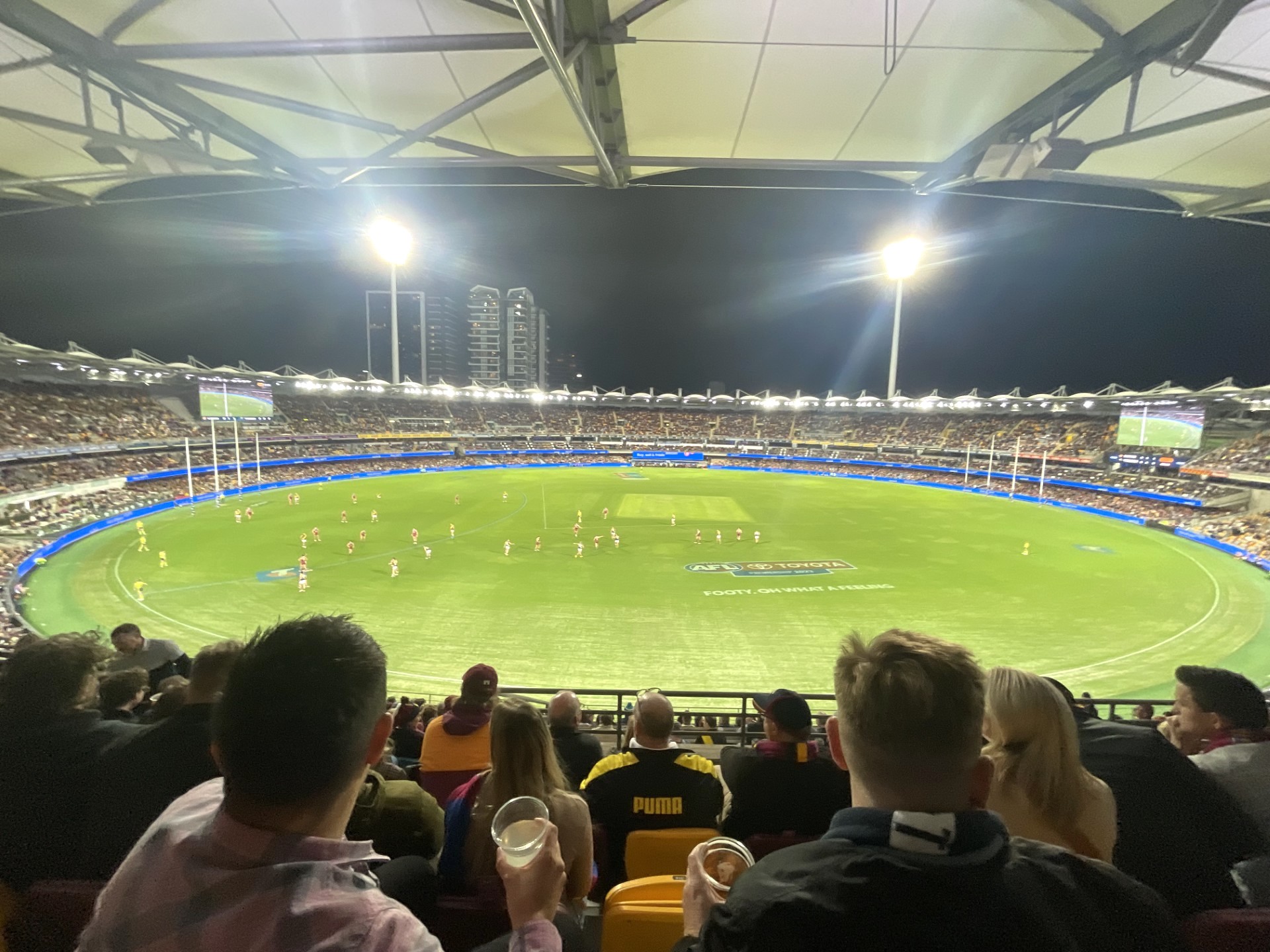
SPORT IS AUSTRALIA’S NATIONAL PASSTIME. BUT THE INDUSTRY’S UGLY SIDE IS GETTING TOO TRICKY TO IGNORE.
Gambling has a massive impact on Australia’s economy.
The you win some, you lose more report released in 2023, headed up by Labor MP Peta Murphy, makes clear how significant a problem gambling is in Australia.
Our nation loses $25 billion per year on gambling. That amounts to more money gambled per capita than any other country in the world.
In 2022, 44% of Aussie adults reported to having bet on sports or racing in the past year. Most spent their money through a phone or computer.
Nearly half of those who gambled in 2022 were classified as at some risk of gambling harm. This can include financial, legal, family and relationship, and health and psychological harms and homelessness.
Gambling is as much driven by economic decisions as it is driven by team loyalties, or the thrill of a win.
It is a poor economic decision driven by poor economic justifications that result in poor economic outcomes. At the heart of these struggles are emerging theories of behavioural economics.
Behavioural biases are systematic economic mistakes that result from mental decision-making shortcuts. These abound in the gambling market, but two stand out.
There is the gambler’s fallacy, which is the expectation that one’s luck is ‘due’ for a change after a long period of consistent outcomes.
For example, an AFL team from the West Coast that has never won a flag might seem ‘due’ for a change of the tide… but that’s not quite how it works.
On the other hand, some fall for the hot-hand belief, which is false trust that a team who has a winning streak will continue in that fashion.
For example, a Western Sydney NRL team that was top of the ladder before finals might be slated as shoo-ins for the premiership decider. That clearly isn’t how 2026 worked out for the Panthers.

Punters line up at betting vans at the 2016 Melbourne Cup. Credit: Flickr
The error in both of these behavioural justifications is the assumption that a team’s luck is influenced by what has happened prior to the game that you are betting on.
If you flip a coin repeatedly and get heads four times in a row, the probability of tails does not increase because it is ‘due’, nor does the probability of heads increase because you are on a roll. The chance of either remains a 50/50 toss up.
Behavioural biases are how punters can self-justify their big bets. It creates an illusion of control, where gamblers think that they know more than the bookmakers, and are comfortable spending more.
While the gamblers’s fallacy and the hot-hand belief are the big dogs of the gambling-related behavioural biases, there are plenty of other effects that keep gamblers hooked.
Mental accounting is a phenomenon where the average consumer does inaccurate mental maths, often with a bias towards being better off. This leads to underestimation of the likelihood of losing and miscalculation of the size of potential losses.
You won’t find many people at the TAB with a pen and paper out to calculate the expected value of the bet. Calculations are often mental, as if they are optimising their spending. Of course they will be optimistic about their chances!
Anchoring or default biases are preferences towards what is presented as the ‘standard’. For example, the suggested starting bet on a gambling app.
All biases are propped up by ‘herd behaviour’. As gamblers become increasingly problematic, and develop social circles that rely on gambling for enjoyment, each other’s habits help to normalise and justify each other. And so, the cycle continues.
Some behavioural economists subscribe to ‘prospect theory’, which claims that an individual’s biased decision making is based on their prospective outcomes: how much they stand to gain or lose.
One pillar of prospect theory is that decision makers are loss averse – that they are willing to invest more money and energy into avoiding a loss than increasing a gain.
That is why punters might keep pushing their luck in an attempt to make up for what they lost. Possibly because they think their luck will turn.
Another pillar is skewed probability weighting. Prospect theory says that consumers underweight the likelihood large probabilities and overweight smaller ones.
That’s why bets with low-probability still get significant uptake, particularly when they are framed in a manner that masks their poor chances.
For example, same game multis are hugely popular, particularly in finals season. But, they are much harder to win.
In a regular bet, a gambler has to satisfy one condition to win (like, the Newcastle Knights win the NRL Grand Final).
In a multi, a punter has to satisfy several conditions at the same time (like, the Fremantle Dockers win the AFL Grand Final, the margin is 12 points, and Will Ashcroft wins the Norm Smith Medal).
This particular style of miscalculation is explained by ‘bounded rationality’: a behavioural bias that says there are limits to the comprehension of risk when bets become increasingly complex, and the downfalls of mental accounting.
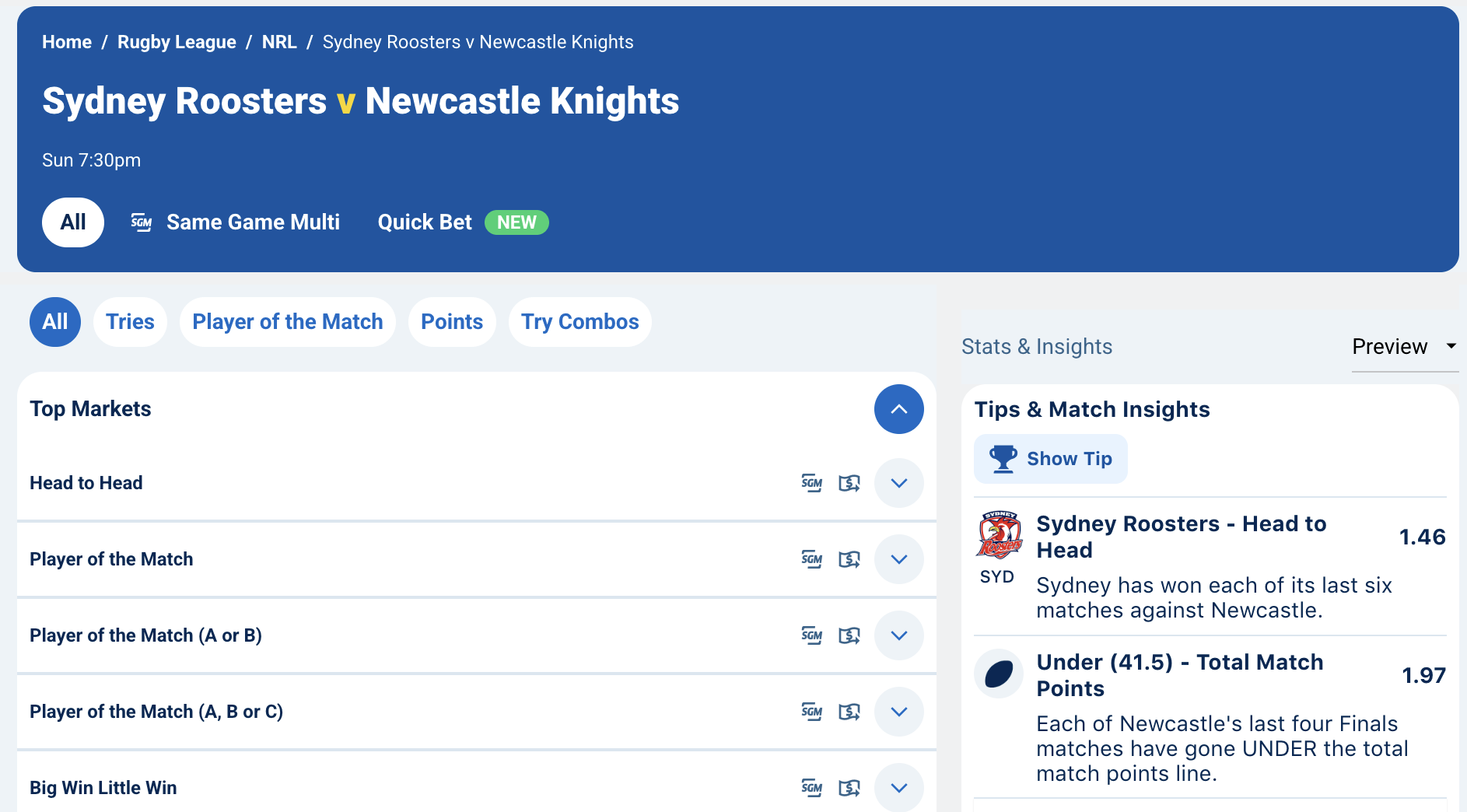
Sportsbet, one of Australia’s leading online gambling websites, is offering an endless range of betting markets for this weekends , NRL Grand Final.
More often than not, gamblers are blind to the real odds of losing.
Casual gamblers make bad economic decisions. Regular gamblers are addicts.
This year’s senate inquiry into online gambling brought attention to how aware some companies are of the harm they are doing to users.
The allegations include offers of free money into betting accounts for known problematic gamblers, to offers for provision of drugs to liven up the party at sports events. All it need is a few clicks to place a bet discourages consideration of the economic losses that the decisions could lead to.
Endless tables and numbers and statistics creates an illusion of a wealth of information. But stats on past performances cannot guarantee future outcomes.
‘Quick bet’ options, which recommend dollar values to bet on varying odds play on the default bias of users, offer a simply pick.
In 2023, Peta Murphy MP’s you win some, you lose more report laid out thirty-one recommendations to deal with Australia’s gambling problems.
Most notably, the committee recommended “…implement a comprehensive ban on all forms of advertising for online gambling, to be introduced in four phases, over three years, commencing immediately.”
This clearly has not happened. In fact, it has been nearly three years since that report was released. The chair of the committee, Peta Murphy MP, has since passed away.
If actions are not taken now to protect gamblers from their addictive habits, when will they be?