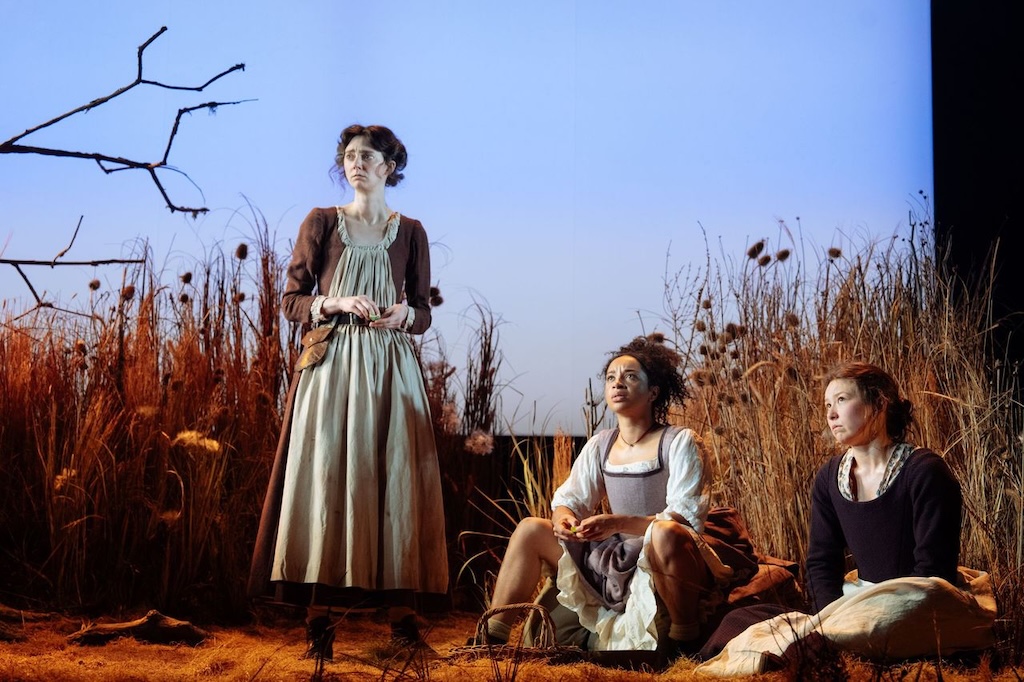
Witty, thought-provoking and shocking: Tanya Reynolds, Siena Kelly and Liv Hill in 1536
If this play ever comes to Sydney, grab yourself a ticket immediately. It’s called 1536 because that was the year that Henry VIII decided, on spurious grounds, to have his wife’s head chopped off, but this is not a history lesson as such. It is more about how that royal murder affected the lives of Tudor women, including those completely unassociated with court life, and their lack of agency. And although the action takes place five centuries ago, and women’s rights have improved tremendously since then, let’s not pretend that there is parity and that double standards don’t still abound. (This is not the place to quote figures about equality in pay, in conditions, in representation etc etc, or imagine misogyny isn’t rife.)
Back to 1536: if the head of state (and church) decides it’s OK to kill his wife, what are the ripple effects for all the women in the land? Three unmarried young women, friends since childhood, meet regularly in a field outside their rural village in England’s Essex to exchange news and gossip. Mariella (Tanya Reynolds) is a midwife, not a vocation she chose but one expected of her; Anna (Siena Kelly) works for one the lords of the manor and is a free spirit (and free with her sexual favours); she likes to challenge the status quo just a little bit. And then there’s Jane (Liv Hill), not the brightest spark in the sky, but very much part of the group – and she’s about to be married off, courtesy of parental arrangements.
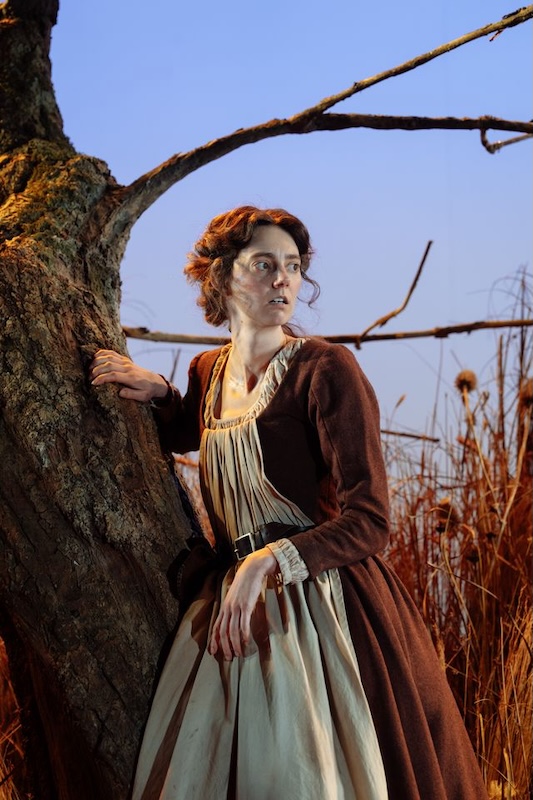 At first, they think that what happens in the royal palaces has little resonance for them. As Anna points out forcefully and with some humour, a death of one of local swains would matter more to her than the death of the king. But when Jane bursts in with news that Anne Boleyn has been imprisoned for treason, none of the three can believe it. Imprison the queen? The woman the king pursued for seven years? The one he turned the country upside-down to marry? What is he thinking? Surely, she’ll be out soon?
Of course, we all know that isn’t what happened but Anne Boleyn’s three-week journey from Greenwich Palace to the Tower of London to the block and the executioner has uncomfortable parallels with events happening in rural Essex. Within days of her arrest (and with no hard evidence), Anne becomes the ‘Great Whore’; one of Anna’s conquests, now about to be married to someone else, turns on her with similar insults – the men of the village expect their women to behave, and be compliant. Double standards at all? There’s no sexual equality here; in fact, two women in a nearby village are burnt to death for adultery. As a midwife, Mariella is forced to attend to the wife of the man she was in love with and wanted to marry. There’s more, but the point is these women have no control over their lives and the world is becoming increasingly hostile for them.
This is a fabulous debut play from Ava Pickett (she’s written for screen: How to Get to Heaven from Belfast, The Great and Ten Pound Poms). It runs for nearly two hours without an interval and under Lyndsey Turner’s direction it is engrossing from start to finish, the tension building as the women’s lives begin to unravel. It’s also surprisingly funny – at least until the shocking final scenes.
Max Jones’s set is simple but evocative and the lighting (courtesy of Jack Knowles) changes the mood and atmosphere as events rattle out of control.
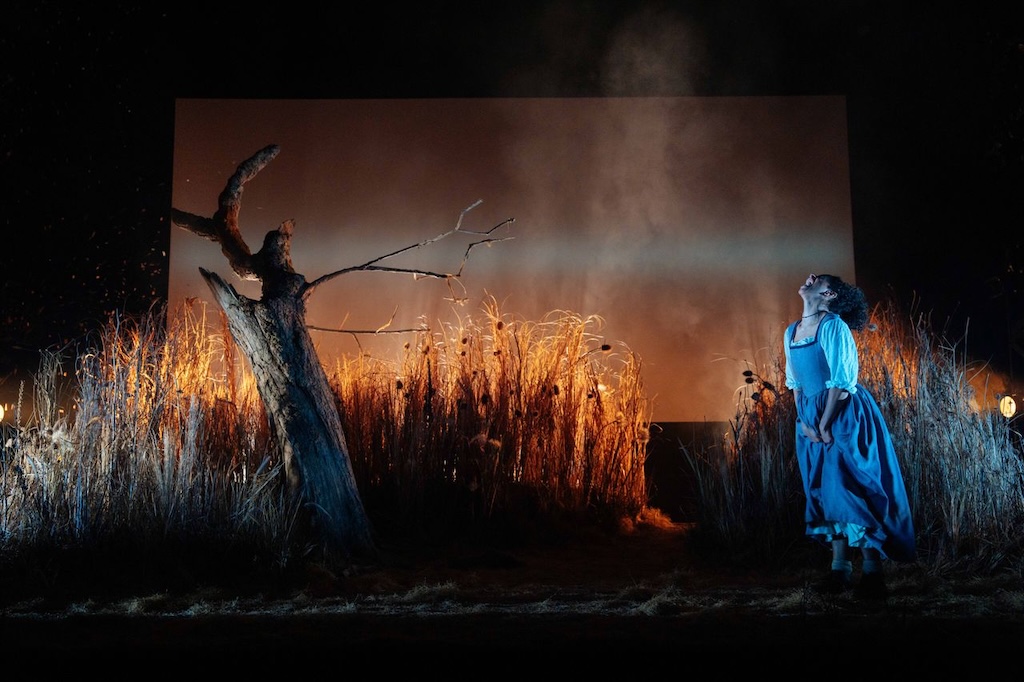 The performances from the three female leads are flawless, honed to perfection from last year’s season at the Almeida Theatre where 1536 premiered. Each woman has a distinctive character and there is much heartfelt banter – their language is robust: Tudor folk were not squeamish about using four-letter words. Kelly, Hill and Reynolds are complemented by Oliver Johnstone as Richard (Anna’s lover and about to be Jane’s husband, and a piece of work) and George Kemp as William, Mariella’s unrequited love and a weak hypocrite.
1536 is witty and thought-provoking and stays with you. At one point, Mariella asks: ‘Will things ever change?” The women in the audience laughed or sighed; the system is still rigged, and some countries’ powerful heads of state are still misogynists.
Unsurprisingly, this second run is a sell-out. I read that Margot Robbie’s production company LuckyChap is behind this Ambassadors season so maybe it will travel to Australia. Fingers crossed. I’d be there to see it again, that’s for sure.