
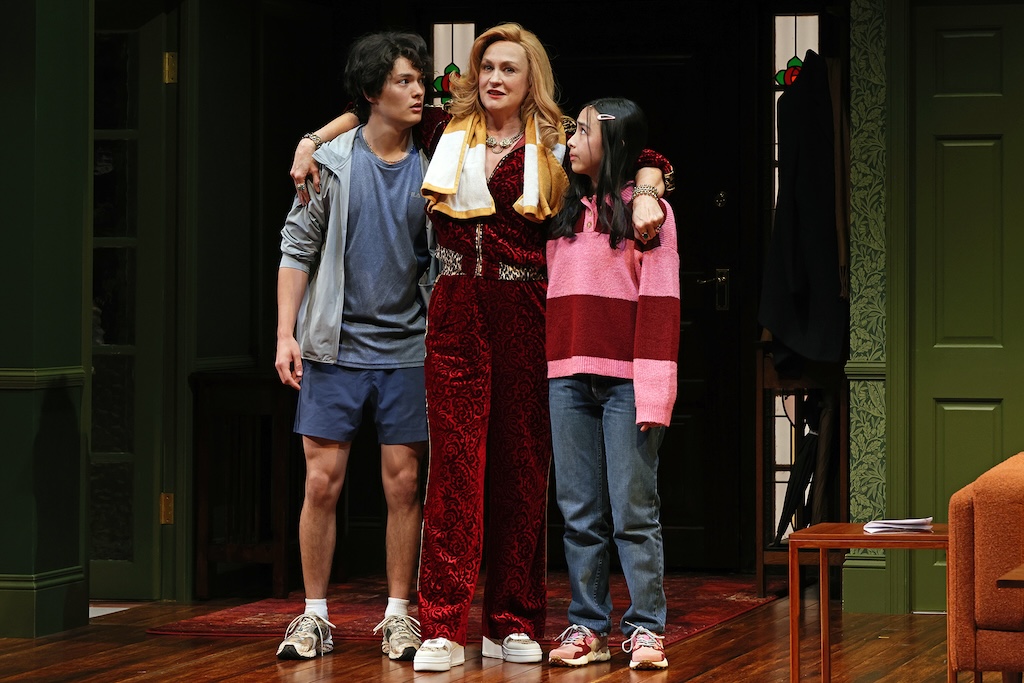
Friend or foe? Arnott and Davies with Thomson’s ‘Murder Poppins’. All photos: Prudence Upton.
Helen Thomson blasts through The Unfriend like a tornado in suburban London in this very British farce that gleefully skewers some of the worst (and instantly recognisable) traits of the English and the Americans. A generalisation, but you’ll see what I mean.
Married couple Debbie (Alex Lee) and Peter (Tim Walter) are thrown into the company of Elsa Jean Krakowski (Thomson) on a cruise. Brash, exuberant and invariably in leopard print, Elsa is everything the two Brits are not but, as holiday companions, they rub along just fine. Elsa makes it her business to know about everyone on board, and proclaim herself an expert on their psyches and motivations. ‘Come see me in Denver!’ she insists, before they part company, and demands an email from the Brits so they can keep in touch. Obviously, Debbie complies – I mean, it would be rude not to, wouldn’t it? She and her husband are the sort of people who would apologise for being in the way if your car ran into them. And that’s exactly what playwright Stephen Moffat is exposing – the embarrassing politeness of this type of Brit against the stereotypical loud American, and in this comedy of manners, the consequences become very funny indeed.
Socially inept and a procrastinator par excellence, Peter cannot even refute his boring neighbour’s persistent (and unjust) demands to go halves on the repair of their communal fence (this is a running gag throughout the play), so he tries to ignore him.
Back home in London, we meet the couple’s teenage children. As Alex, Ty Arnott has a ball being petulantly bored. His physicality as he throws himself around the walls and furniture, all limbs and seemingly few bones, is hilarious. Of course, he is embarrassed by his parents (but that’s not something confined to British teenagers). His sister Rosie (Brooklyn Davies) feels hard done by, constantly complaining about her brother and that she is being ignored by everyone.
Neither Debbie nor Peter know how to deal with them, so they don’t. Debbie is the quieter, more aware, character; she does let rip, but without the manic vehemence.
Enter the neighbour (Huw Higginson). (We never learn his name because it has been forgotten and of course it would be far too embarrassing to admit this to him; he’s lived next door for 10 years.) He has a flat Brummie accent, and is as aggravatingly tenacious in his monetary demands as Peter is obstinately obtuse.
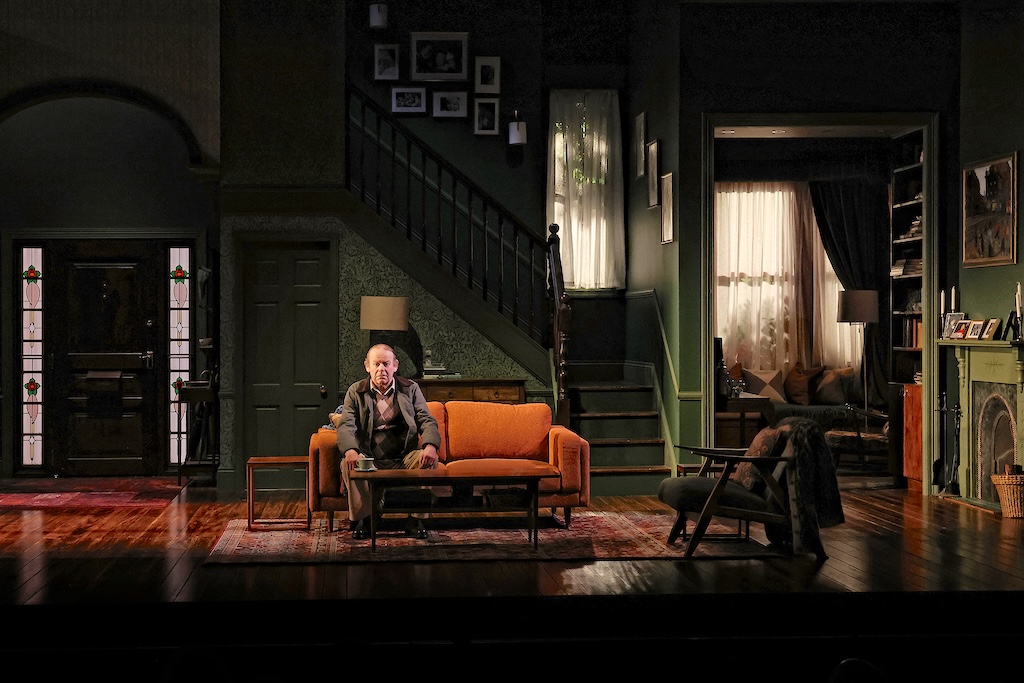
Into this domestic blitz, storms Elsa – completely unannounced and completely determined to stay. When Thomson is on stage, it is impossible to look at anyone else. Elsa is outrageously over the top, in speech, volume and dress (designer Isabel Hudson has had a field day here, both with costumes and the very detailed set). And of course, it would be terribly impolite to refuse their unwanted guest – even when, as Debbie soon discovers through an internet search, Elsa turns out to be a serial killer. (Why she is on the loose, we never find out, but that doesn’t spoil the fun.)
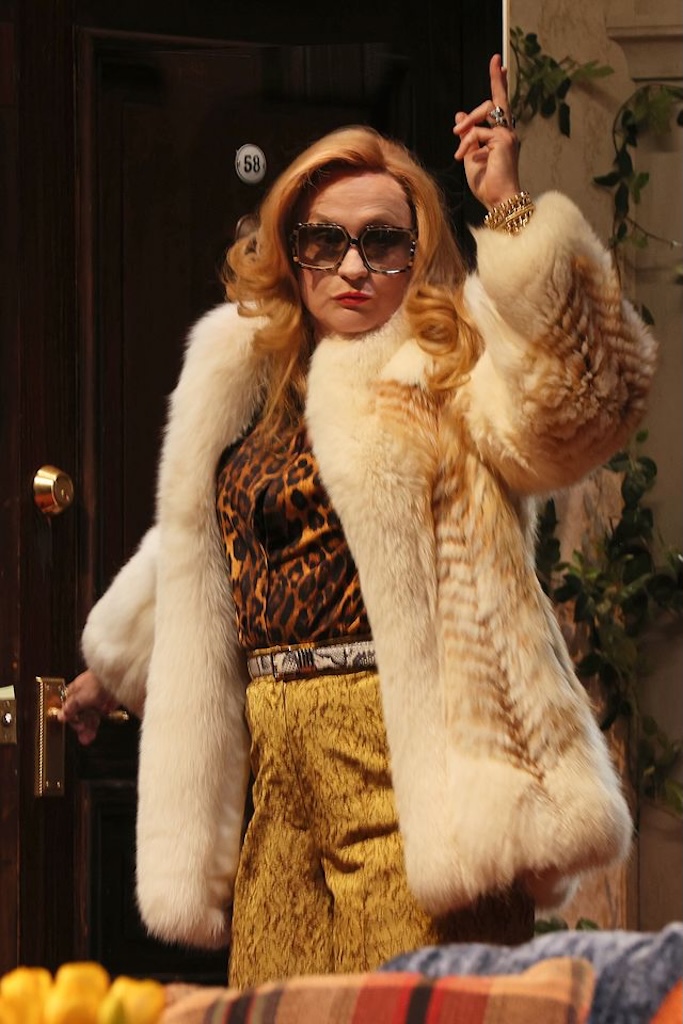 Needless to say, Elsa soon takes over the household. As Peter and Debbie become more and more unable to get rid of her and worry that she is going to murder them all, Elsa ingratiates herself with the teenagers and turns their behaviours around. Not so much Mary Poppins as Murder Collins (playwright Steven Moffat’s gag, not mine.) Meanwhile, the Neighbour keeps turning up and making a nuisance of himself.
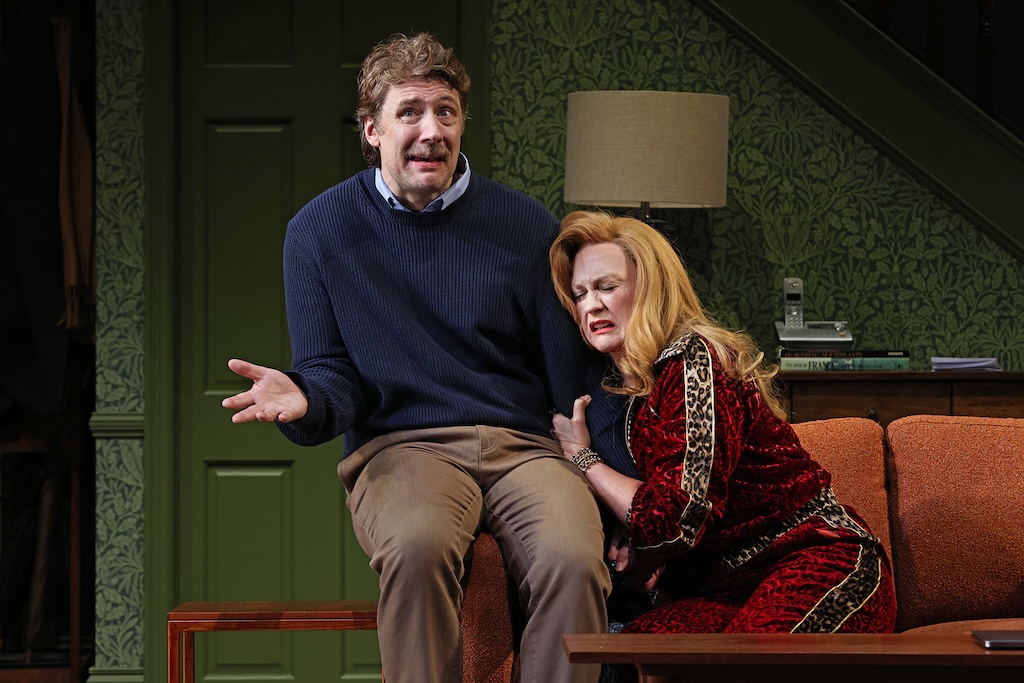 In Act 2, Moffat introduces another scatological element – again, something bound to provoke anxiety in many a Brit (we’ve already heard Peter reprimanding his son on ‘breaking wind’.) Walter’s Peter is also fabulous. He excels in some very laugh-out-loud scenes, his character’s awkwardness increasing as the action progresses, culminating in him brandishing a polluted toilet brush around the living room while his family cowers into the corners. It is Basil Fawlty-esque in its silliness – although Lee’s Debbie is not given such a good role as Basil’s wife Sybil.
Meanwhile, like a barnacle stuck to a ship, Higginson’s Neighbour waits in the kitchen. Waits and waits. Elsa, not bound by British etiquette, doesn’t hesitate to label him ‘passive aggressive’. Higginson doesn’t bat an eyelid.
 It’s all good, clean fun (well, with the exception of the toilet brush), and director Simon Phillips knows how to milk the laughs (his 1995 Les Parents Terribles remains one of my all time favourite nights at the theatre). The cast is uniformly excellent but I cannot imagine this play without Thomas in the lead role. Her comic timing is, as ever, spot on and her expressions and body language speak volumes. Moffat (who wrote Douglas is Cancelled among many other TV scripts) provides some excellent one-liners – (‘What’s on WhatsApp stays on WhatsApp’; and for Elsa, on murdering six people, ‘Is it good to keep those feelings bottled up?) – as well as contrasting the very different realities of Debbie and Peter versus Elsa (and we might say British versus American). The main characters lie and obfuscate in their own particular ways, ways which we all recognise – we only have to listen to the news for more examples. But to escape that horror, see The Unfriend and have a laugh instead.
Until 31 October at the Ros Packer Theatre, Walsh Bay
Tickets $39 (under 30s)–$ 207, plus booking fee
https://www.sydneytheatre.com.au/whats-on/2026/productions/the-unfriend