The Takács Quartet’s performance at Sydney’s City Recital Hall took the audience on a sonic journey through both famous chamber pieces and uncharted contemporary works.
Made up of Edward Dusinberre and Harumi Rhodes (violins), Richard O’Neil (viola) and András Fejar (cello), the group formed in Berlin in 1975. Since then, they have toured the world and released several critically acclaimed recordings chamber music. In the 50 years they have been performing together, the quartet have finessed their distinctive sound. They balance a modern flair with a classical attention to detail, making their repertoire as accessible as it is transformative.
Opening with Hadyn’s String Quartet in G Minor, the audience were immediately pulled into the decorative world of classical music. Filled with playful call-and-response patterns between the upper and lower string, theatrical dynamic contrasts and a rambunctious upbeat tempo, this was chamber music at its finest. The work’s more mediative second movement allowed the players to showcase their uncanny synchronicity through a series of harmonic changes where all four instruments moved as one. The final movement was also noteworthy, reaching a height of dramatics that drew a few excited giggles from the audience. The thundering cello bass notes and soaring violin melodies were punctuated with confident accents that truly brought Haydyn’s vision to life.
Cathy Milliken’s 2025 work Sonnet of an Emigrant was a swift departure from Haydyn. Commissioned to celebrate Musica Viva’s 80th anniversary, the piece drew on Bertolt Brecht’s poetry to capture the experience of displacement. Actor Angie Milliken joined the quartet to recite a compilation of Brecht’s work. Her words were accompanied by a sparse musical landscape where harsh dissonant harmonies reflected the poetry’s focus on isolation and homesickness. While the piece was initially captivating through its creative interplay between words and sound, the music itself failed to achieve a sense of wholeness. It felt a shame to waste the quartet’s virtuosic talent on such an underdeveloped score.
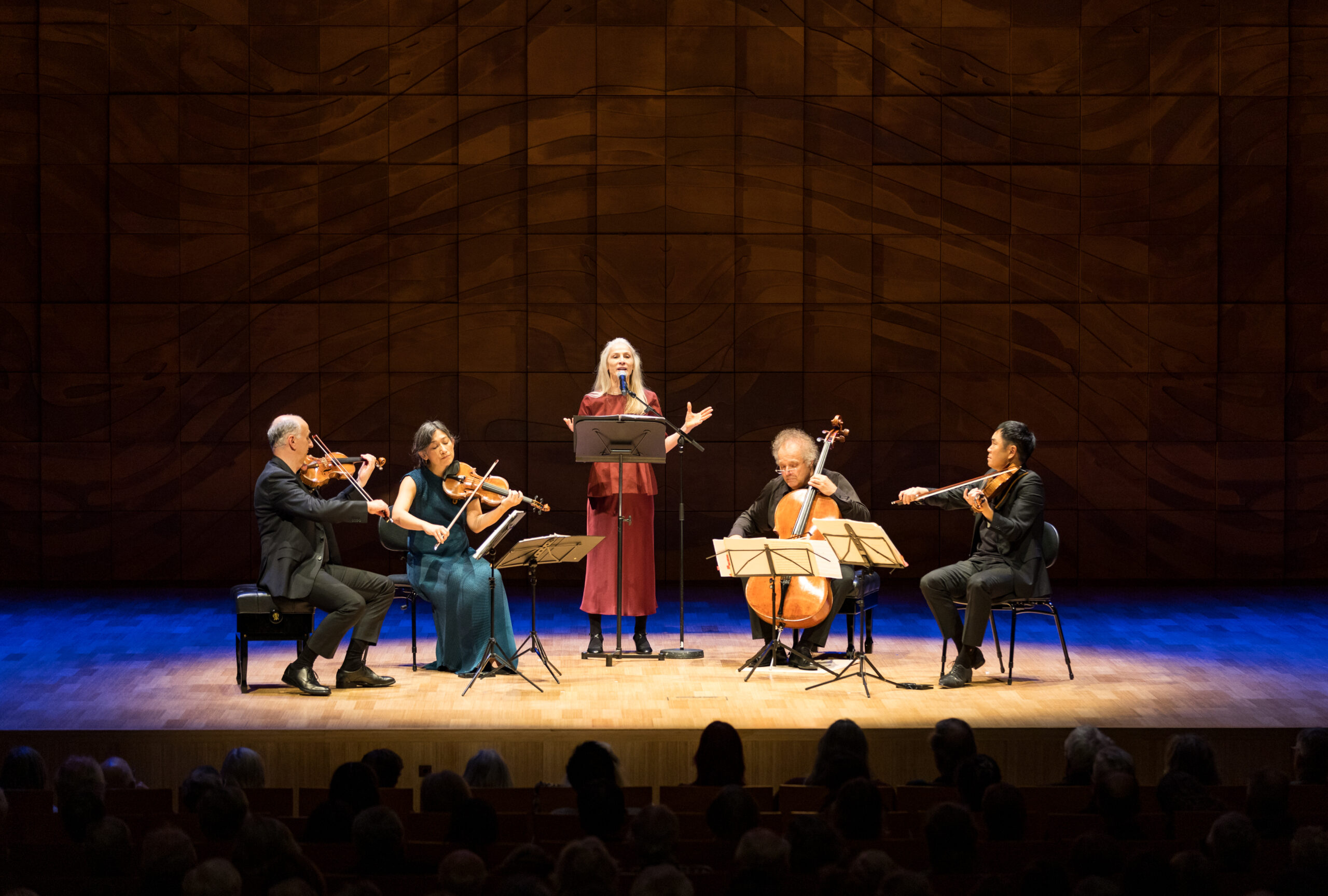
Takács Quartet with Angie Milliken (c) Cameron Jamieson
The final work, Beethoven’s String Quartet in C Major was a much-welcomed return to the more robust sounds of traditional chamber music. The cello’s pulsing pizzicato line in the second movement added a playful charm to the piece, while the upper strings dazzled with complex melodic phrases that kept the audience on the edge of their seats until the final satisfying complex.
The quartet’s anticipated encore was the second movement of Ravel’s String Quartet in F Major. While all four players captured the movement’s light pastoral energy through their playful strumming, it was the rich amber tones of the viola that was particularly delightful.
Passionate, energetic and meticulous in their performance, the Takács String Quartet are a must-see for anyone who finds joy in hearing chamber music come alive.
The Takács Quartet will be performing in Brisbane on 20 August, Adelaide on 22 August and Perth 25 August.