On the eve of a blisteringly hot summer’s day, Musica Viva Australia’s A Winter’s Journey is nothing short of transformative.
Its program, Winterreise, one of the world’s most notoriously challenging song cycles, both for the interpreter to perform and the audience to grasp, is composed by Austrian maestro Franz Schubert, accompanying 24 poems by German poet Wilhelm Müller.
Considered the finest and defining example of German art songs for voice and piano, or the genre Lieder, it follows a young man rejected by his loved one, wandering in the snow and dark of deep winter, in an emotional and personal exploration characteristic of the genre.
An eternal challenge of classical marvels adapted and re-adapted is the question of what’s new with each interpretation. Silhouetting master operatic Allan Clayton and dynamic pianist Kate Golla are a towering presence on stage. To frame the haunting performance legendary landscape artist Fred Williams’ absorbing paintings of the Australian bush strike, explode and throw the well-known repertoire into our imaginations like never before.
The stage is set. Clayton magnifies the space, filling it with a sonorous tenor deep and agile, stable despite fully engaging with the stage. In his complete transmutation into the role, he gazes grievously offstage and into the audience, as if it were his beloved’s house or the wintry landscape ahead. He traces the lines of the painting as if it was his route, rests on the grand piano as if he was a weary traveller and it was a rock, or a cave he lays to sleep under with his coat as a pillow. As Williams’ desolate whites, bloody reds and consuming blacks threaten to envelop the stage, Clayton is the sole wanderer, the only human element with and through whom we experience the environment, transported with his voice and acting.
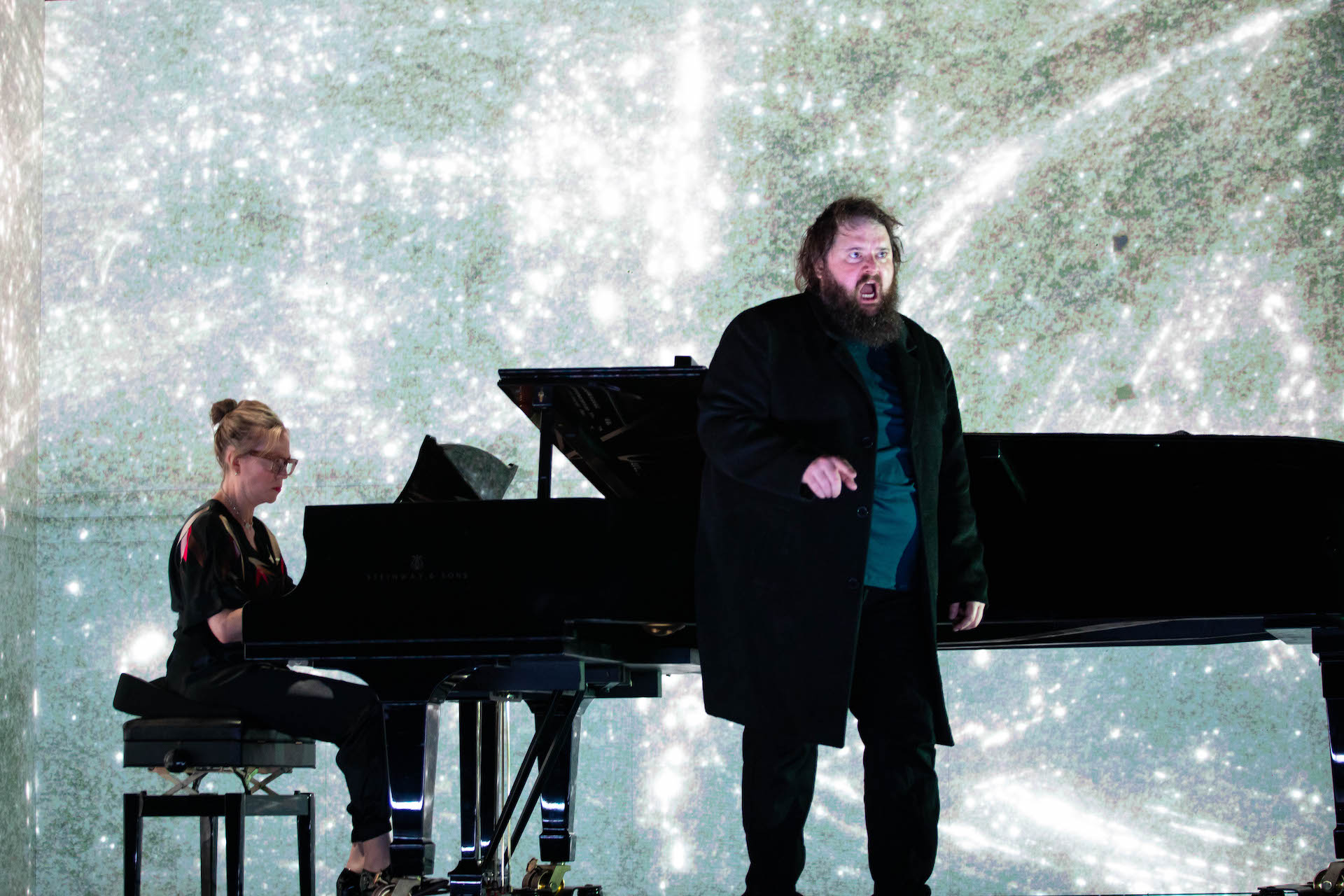
Allan Clayton and pianist Kate Golla in A Winter’s Journey. Photo: David Cox
Golla’s piano brings to life the second voice on scene, and what a chorus it holds, especially in vocalising the natural environment, a major Winterreise character in its own right. The sudden howling wind in The weather-vane, with trilling keys that require adept control, or the soaring high note revolutions in The crow, reminiscent of a bird wheeling and watching, and especially the final song of The organ-grinder/the hurdy-gurdy man, sinister and recurring with the left and right hand in dialogue with Clayton, with many interpreting our hero’s dance with death – “Strange old man. Shall I come with you?”
Paralleling Schubert’s love of Müller’s poems as muses of art and inspiration, director Lindy Hume and production designers David Bergman and Matthew Marshall stage this theatrical transformation with the carefully restrained passion of curators that is nevertheless obvious.
An undisputed classic set in the depth of winter and performed at the height of summer, if you’re looking for musical dive, this is as refreshing as it gets.
In Sydney, David Larkin presented a pre-concert talk in the function room on Level at the City Recital Hall, Sydney.
A Winter’s Journey tour :