
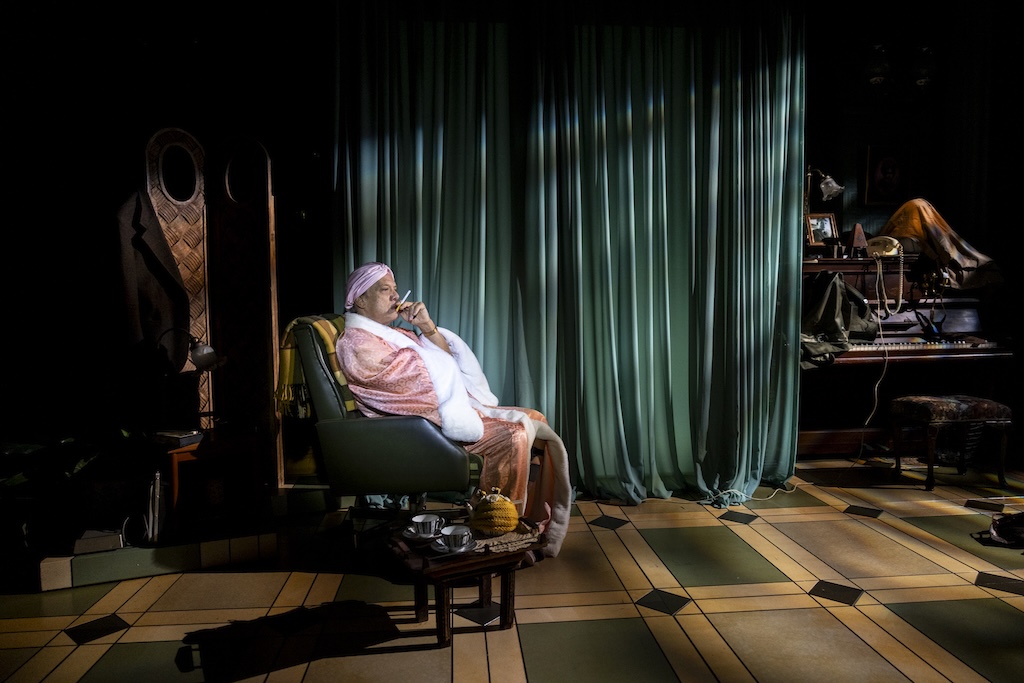
Under wraps: Simon Burke as Robert O’Brien. Photo: Brett Boardman
Simon Burke is just fabulous as the beleaguered and maligned elocution teacher in this Steven J Spears play, which premiered 50 years ago, and charts the downfall of a man persecuted simply because he is gay. And therefore deemed to be a danger to children. And presumably the public at large, whoever they might be.
It opens to Robert O’Brien (Burke) stark naked and swanning around his flat, caressing a large poster of Mick Jagger and indulging in a little erotic fantasy to the strains of David Bowie’s ‘Jean Genie’. It’s a great start. The phone rings and O’Brien turns down the music, loses his lower-class accent and announces to the caller, in suitably plummy tones: ‘Shakespeare Speech and Drama School’. As it happens, the caller is not a prospective client but Robert’s friend Bruce, a besuited stockbroker by day and glamorous transvestite called Belinda at night.
The next time the phone rings it is a client – a Mrs Franklin, who wants elocution lessons for her stuttering 12-year-old son, Benjamin. And so we learn about Robert’s day job – and Burke’s wonderful range as he gives us a rundown of the teacher’s monotonous life, helping stammerers and lispers, exhorting his charges to breathe into their diaphragms, imitating them all without missing a beat, threatening some, such as Moira (who won’t learn her tongue twisters) with an awful death, and learning more and more about Benjamin Franklin.
Benjamin turns out to be a very precocious 12-year-old, whose smoking habit, his affair with his hairdresser and his sexual exploits come as a happy surprise to Robert, who gleefully reports all to Bruce. He’s taken with the boy – ‘I think what he really needs is a father figure,’ he says. He sees potential in Benjamin, thinks he could be an actor and arranges an intro for him. ‘This kid could save me,’ Robert tells Bruce. But he’s not trying to seduce him; in fact, he tries to tell Benjamin he should go straight, it’d be easier for him. ‘Try women,’ he suggests. ‘They’re nice; they’re soft. They’ve got tits.’
Robert, flamboyant in the privacy of his own home, must be constantly on the alert. But his nosy neighbours in Double Bay are already on to him. Before long, a brick crashes through his window. Radio commentary of the day (1976) is indistinct but prejudices are clear. When the police storm Robert’s flat and find him in a wig and a frock, and partially burnt indecent photos given to him, unsolicited, by Benjamin, it’s the beginning of the end.
The Elocution of Benjamin starts out sharp, witty and funny but subtle shifts of lighting and moments of lonely introspection from Robert hint at tragedy that will befall him. Comedy gives way to more and more tension, under Declan Greene’s tight direction, aided by sound (including a cuckoo clock) from composer/sound designer David Bergman). It all combines to great effect.
The final scenes are compelling and sad, with Robert incarcerated and desperate to hang on to ‘his soul’. He’s now in Callan Park, imprisoned without a trial, for being himself. Robert’s final words: ‘Help me.’
Burke masters these transitions with flair and skill; it is marvellous performance. And as the program notes: Half a century on, [this play] is just as urgent – and unsettling – as ever.
It’s a Griffin Theatre production, showing at Belvoir Downstairs until 29 March.
Tickets: $40-$72
More: https://griffintheatre.com.au/whats-on/the-elocution-of-benjamin-franklin/or (02) 9361 3817