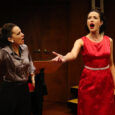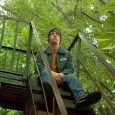

Lost soul: Tom Conroy as poor Tom. Photo: Brett Boardman
Old men behaving badly. Old men with power, who rule kingdoms or countries, behaving badly? Yep. Should parents be wary of giving too much dosh and agency to their offspring? Probably. Not much has changed since Shakespeare’s King Lear first entertained audiences back in the early 1600s. And the play itself was sourced from stories much older than 420 years ago. In this grandly titled production – The True History of the Life and Death of King Lear and His Three Daughters – director Eamon Flack says, ‘We’ve used a version of one of its original titles, which gives you a sense of the play’s real scope of interest…’ but he doesn’t say which one, so we are left guessing. There were so many versions of the story extant in Shakespeare’s time and the tale was already old; it probably arrived in England around 1135 via Monmouth’s Historia Regum Britanniae, but elements of the plot were already widely known in European folklore and one play references a King Leir who ruled 3000 years ago. So it has endured.
In this production, in which Colin Friels takes on the title role, Flack has dispensed with props and scenery to let the text take centre stage. The lighting is bright, the floorboards bare and a chair about the only other thing to appear on stage, bar a dagger or two. And, of course, blood.
Nearly everyone who goes to see King Lear knows what happens.The king is about to split his kingdom evenly between his three daughters, Goneril (Charlotte Friels), Regan (Jana Zvedeniuk) and Cordelia (Ahunim Abebe). Goneril and Regan fall over themselves in praising their father (‘dearer than eyesight,’ declares Goneril, foreshadowing events to come) but Cordelia is no sycophant. What can she add to her sisters’ fulsome words? ‘Nothing,’ she says, insisting her love is everything it should be as a loving and dutiful daughter. Lear, in the way of despotic monarchs/prime ministers/presidents used to hearing only what they want to hear, is outraged, disinherits Cordelia (who leaves to become the wife of the King of France (Conor Merrigan-Turner)), and names Goneril, married to the Duke of Albany (Sunny Singh Walia) and Regan, married to the Duke of Cornwall (not a nice chap, played here by Charles Wu), as his successors.
Lear’s advisers are stunned. But in yet another mirror of contemporary politics in some parts of the world, those who dare to speak the truth find themselves harried and/or silenced. Honest, self-sacrificing Kent (Brandon McClelland), who does so dare, is banished and when he reappears disguised as a peasant is put in the stocks for fighting with one of Cornwall’s men.
The other pivotal adviser is Gloucester, a duke in all Shakespeare’s variations, but here he becomes she with Alison Whyte, taking on the role as the Countess – and making that transition work nicely. Her performance is one of the best here. We learn early on that the Countess has two sons – the legitimately conceived Edgar (Tom Conroy) and the bastard Edmund (Raj Labade). Of course, back in the day, being ‘base born’ was a shameful cross to bear and Labade makes the most of his role as the evil Edmund, doing all he can to incite dissent and frame Edgar as a would-be villain and murderer, providing a nice sub plot to the machinations of Goneril and Regan.
Before long, Lear is wandering the heath, losing the plot rapidly and bemoaning his feeble state and the nastiness of his daughters. Is this The True History of the Life and Death of King Lear & His Three Daughters recognisably different from other versions you may have seen? There are subtle differences, and probably some I didn’t notice. Regan gets to poke out one of Gloucester’s eyes in this version (yes, that’s right); Edgar, himself going mad in the middle of the play, seems to have an expanded role but this could just be because Conroy makes such a fine job of being ‘poor Tom’ and, later too, when he has regained his wits in the concluding scenes of Lear. Conroy was another highlight of this Lear.
At other times, there were disappointments. On the night I saw it, Shakespeare’s fabulous ‘cataracts and hurricanoes’ speech, which Lear delivers as he rages against the storm (political and temporal), was almost completely obliterated by the sound effects of thunder, the darkness of the lighting, and the increased volume from the otherwise delightful trio of musicians (Hilary Geddes, Jess Green and Arjunan Puveendran).
And I do so wonder what Shakespeare would make of some of the productions of his plays 400 years on. In this one, James Stibilj is credited as costume designer, but the audience could be forgiven for thinking the cast had just walked in from the street. Not helpful in a play that has so many dramatic personae and one in which some actors play two roles. When Peter Carroll (the Fool) appeared in the final scenes, dressed in a different shirt, I wondered who he was? Surely not the Fool, but if not him, then who? And Charles Wu also appears towards the end, after he has carked it as the Duke of Albany. Confusing? Yes. And why wouldn’t Regan (vindictive, though she is) change her blood-stained shirt after she’s gouged out one of Gloucester’s eyes.
Still, Shakespeare’s words are still there, rich and laden with meaning to help us ‘see better’ and allow ‘ruinous disorders to follow us disquietly to our graves’. But buckle up, because this The True History of the Life and Death of King Lear & His Three Daughters runs for three hours and 15 minutes (with two intervals).
It’s at the Upstairs Theatre, Belvoir St until 4 January 2026
Tickets: $41-$97