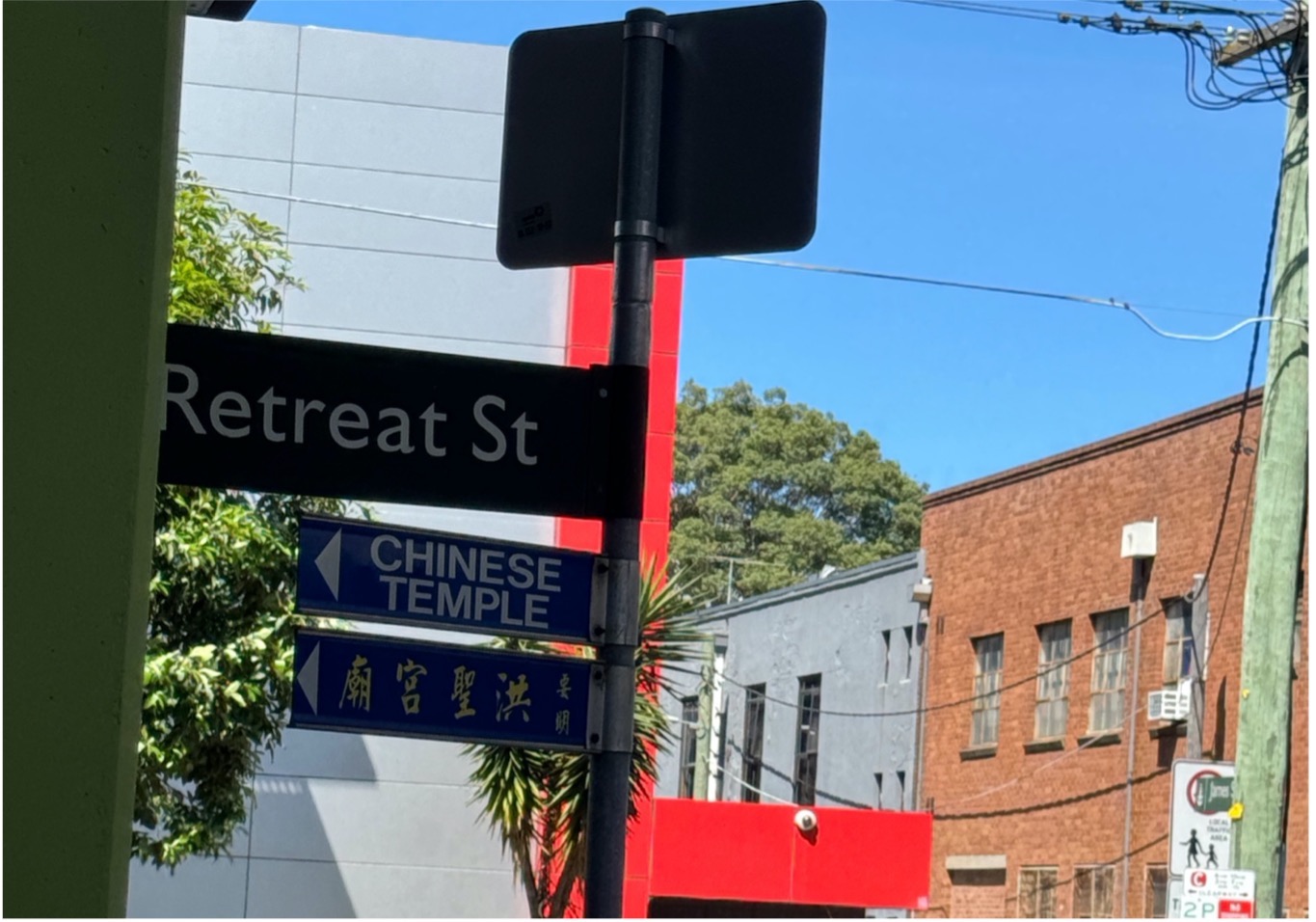
Yiu Ming Temple on Retreat Street, Alexandria, is surrounded by factories and apartment buildings in Sydney’s inner west. Photo: Shilei Wang
For over a hundred years, the Yiu Ming Temple has stood on Sydney’s Retreat Street, nestled among factories and apartment buildings, enduring the city’s changes.
Founded in 1909 by migrants from Gaoyao and Gaoming in Guangdong, Southern China, it served not only as a place of worship but also as a refuge for those who had migrated across the sea and couldn’t return home. Faith acts as a source of resilience in its calm presence.
The temple holds two stories; one is engraved on its inscriptions, and the other is embedded in every grain of incense ash that eventually cools.
I stood amidst the glow of lamps, my camera an extension of my eyes. When I pressed the shutter, I could hear my breath synchronise with the distant, faint sounds of chanting.
“Come in,” said one of the temple workers. As I walked inside the temple, images of a faraway land came to mind. My footsteps slowed and lightened.
A distant memory surfaced. The first time I entered a temple in China as a ten-year-old, dwarfed by towering statues, the air thick with the smell of incense and the murmur of unfamiliar prayers. I could almost hear the murmur of a woman beside me whispering, “Please, bless my family.”
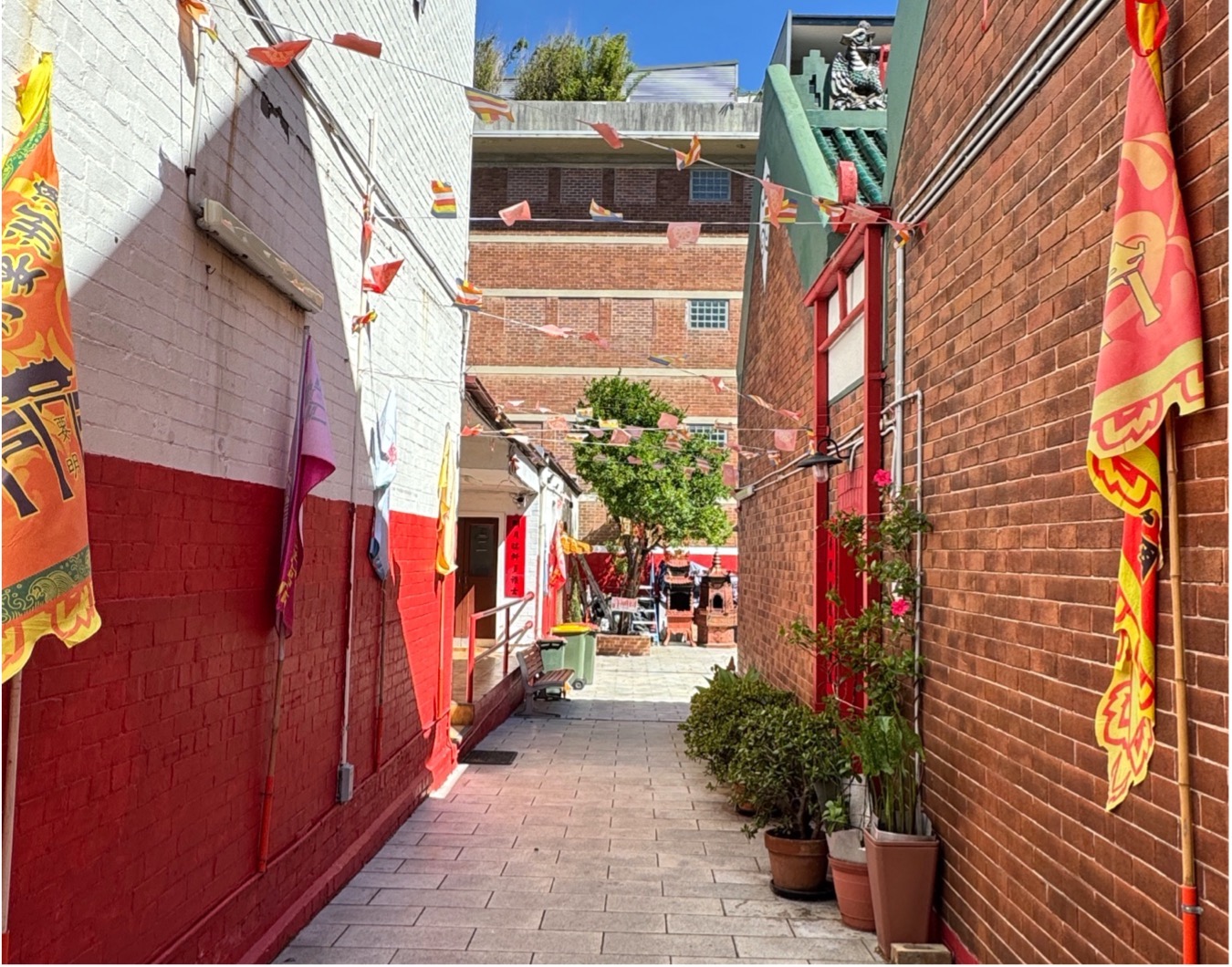
Prayer flags adorn a narrow corridor inside Yiu Ming Temple on Sydney’s Retreat Street, Alexandria. Photo: Shilei Wang
I watched blue smoke, entwined with the coldness of the old wooden beams and pillars, swirl through the crisp air. Here, life turns to ashes and is forever reborn. Yiu Ming Temple stands silent, as it has for decades, transforming all prayers, hesitations, and moments into drifting dust that sinks into its wordless silence.
The entrance to Yiu Ming Temple, a quiet threshold separates the bustle of the street from the calm of the inner courtyard.
Alexandria, an industrial inner-city suburb of Sydney, is a symphony of steel and concrete. In the morning rush hour, the traffic flowed under the direction of the traffic lights.
The jacarandas were bursting into purple, and Sydney’s weather was looking warm and inviting for a summer ahead. A quaint old-fashioned pub welcomed visitors along the street, just a short walk away from the gate of Yiu Ming Temple.
Inside the gates, the bustling noise fades away instantly. Some visitors bowed their heads together, silently praying, their eyebrows cast in a sad shadow. Others looked up at the light from the roof, eyes clear, as if searching for some answer.
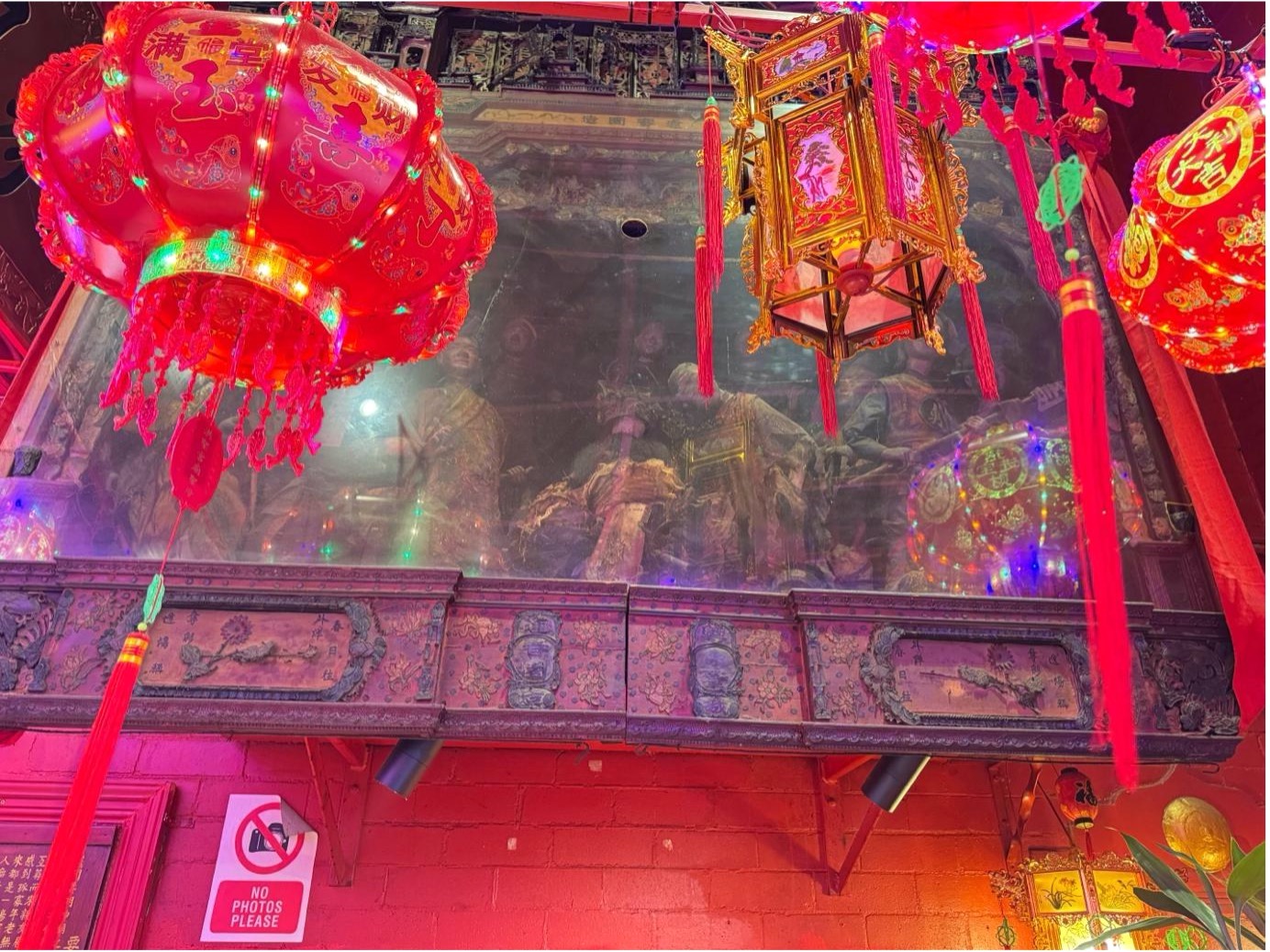
A “No Photography” sign was on the wall, so I put away my camera, keeping only my memory: a dark prayer room, a statue of King Hung Shing in the shadows, and a wooden box labelled in Chinese and English on the table. Buddhist tranquillity and Cantonese tradition coexist in the Sydney temple.
My ancient awe returned. Now, standing in this temple so far from home, it wasn’t just my feet moving, but I was slowly sinking into a familiar, yet newfound tranquillity.
The Heritage List of New South Wales describes Yiu Ming Temple as “a rare example of a Chinese vernacular building in Australia”. Its design combines the traditional village layout of Guangdong with Australian Federation-period architectural details.
The green-glazed tile roof, carved wooden beams, and painted door gods have all been officially recognised as having high heritage significance. It made me realise that what was before me was not just a place of worship, but a living historical site acknowledged by the government and situated in inner-city Sydney.
Over the decades, the temple has been a sanctuary for the community, a place of worship, accommodation, and support for new Chinese immigrants in Sydney.
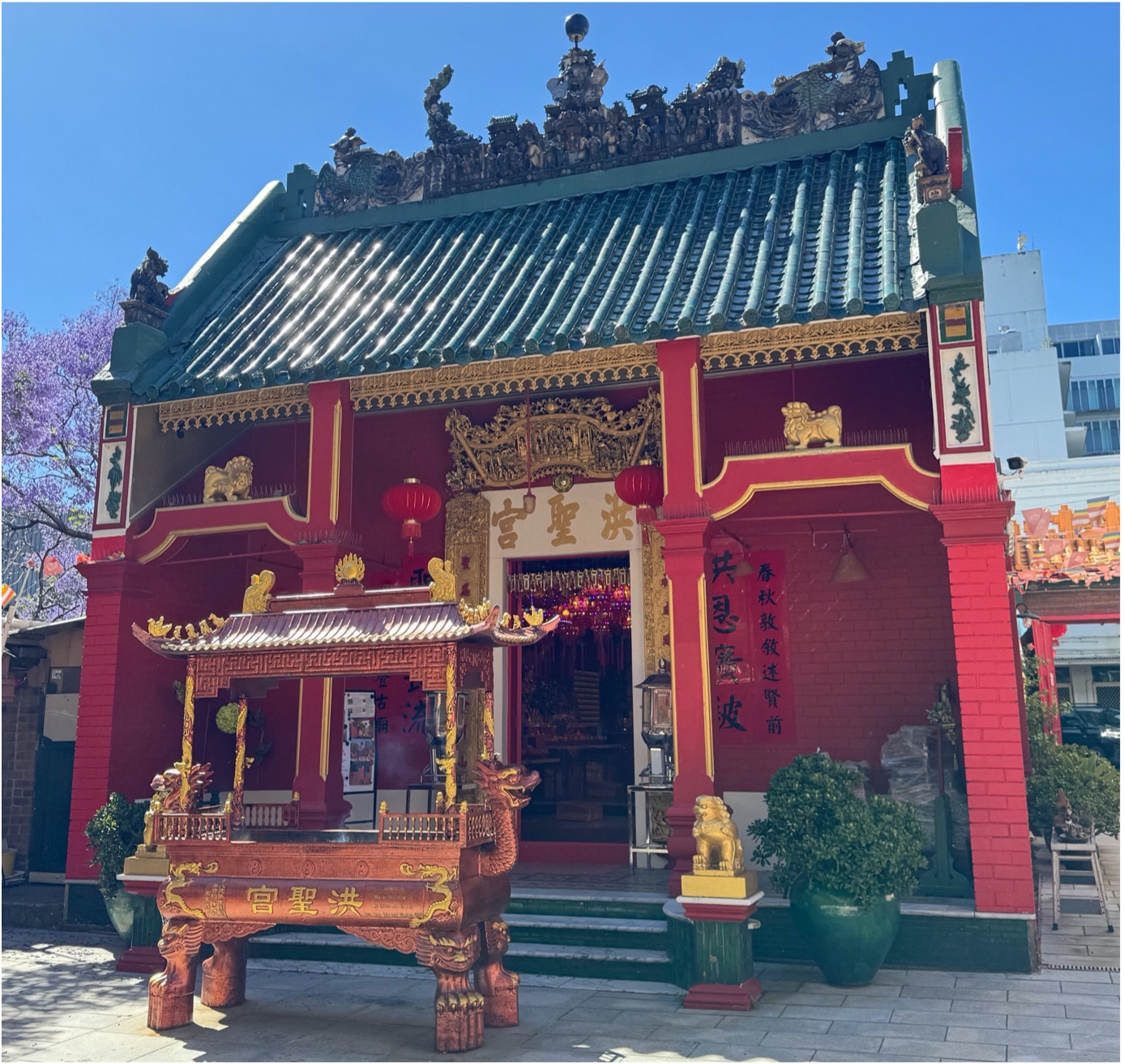
Green-glazed roof tiles, carved wooden beams, and painted door gods — architectural details recognised for their heritage significance. Photo: Shilei Wang
In the main hall, a man in his sixties wiped the wooden altar table. His motions were slow and careful. “I came here three years ago,” said Han Dongcheng, a staff member responsible in the temple.
He told me that before coming here, he had been managing affairs at another Chinese temple. Yet, the daily chores were no longer just a duty but had gradually become a form of spiritual practice. “Sweeping the floor, lighting the incense… these are not chores. This is how I keep my heart calm,” he said. In his view, sweeping away the dust from the Buddha statue is also clearing the hustle and bustle from his own mind. Guiding lost pilgrims is more like building a bridge of goodwill between people’s hearts.
“It [the temple] burned about twenty years ago,” he said, pointing out the traces left by the fire.
The NSW Heritage List records that the temple was destroyed by a fire in 1997. The areas affected by the flames have since been preserved and repaired, remaining embedded in the walls.
Scorch marks on a wooden beam, preserved after the 1997 fire as a record of loss, resilience, and renewal. Photo: Shilei Wang
Amid the ashes, hope persisted. The rebuilding began not with bricks and tiles but with a document: the “Hung Fook Tong Society Temple Restoration Donation Roll.”
The heritage list confirms the difficult years, from 1997 to 1998, when the Hung Fook Tong Society rallied the community, initiating a trans generational act of self-preservation. The names and donation amounts on the roll recorded not only the funds for restoration but also each member’s devotion to their spiritual home.
From craftsmen’s families generously giving to young labourers offering their sweat, the community united and, brick by brick, rebuilt the Yiu Ming Temple from the ruins.
Because of this, the preserved scorch mark on the beam is no longer a scar of devastation but a symbol of honour, a testament to the resilience and unity of the Hung Fook Tong Society.
“Have you met any visitors over the past three years who left a profound impression on you?” I asked Mr Han.
His movements slowed. He straightened up, and his gaze scanned the silent Buddhist altar as if searching his memory. For a moment, he turned back, a complex smile flickering between emotion and helplessness. “Sure,” he said. “He is a dentist, quite well-known in Sydney, actually.”
He paused for a moment, weighing his words carefully. “He was in serious trouble. A procedure failed, the patient sued for a huge payout, and if he lost, everything he’d built over decades would be gone.”
“And then?” I asked.
Mr Han’s smile deepened, showing the certainty of someone who had seen a minor miracle. “Later, he won the case. The court ruled he didn’t have to pay. After winning the lawsuit, he came back again. That time he didn’t come to ask for a favour, but to fulfil a vow.”
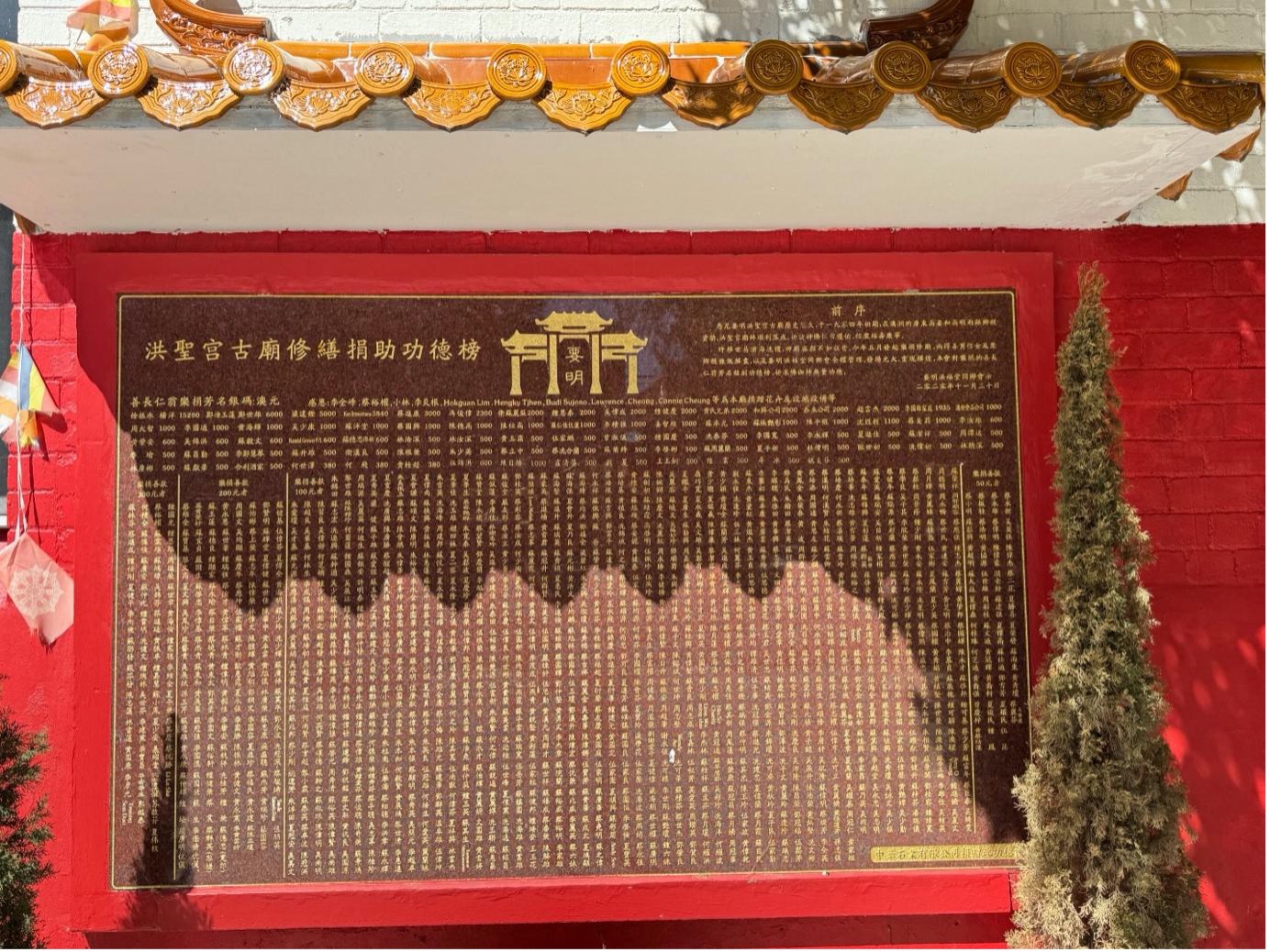
The Hung Fook Tong Society Temple Restoration Donation Roll documents the collective effort to rebuild the temple after the fire. Photo: Shilei Wang
The temple doesn’t ask what visitors pray for; it simply provides a place for anxious hearts to rest. A gust of wind swept through, causing the prayer ribbons around the trees to flutter. I browsed the hanging wish cards. With a few strokes, it was filled with blessings for their family and friends, and they hoped for peace and good health.
A few days later, in a small office behind the main hall, I met two men guarding the temple’s legacy: Mr Su Panqiang, president of the Hung Fook Tong Society, and Office Director Zheng Rongqiang (Tony Trinh). The room had a gentle aroma of tea, and sunlight slipped through the windows, illuminating stacks of documents against the wall.
“This was never just a temple,” Mr Su Panqiang revealed.
“Our heritage register clearly states: ‘Place of accommodation’. For those drifters back then, who had left their hometowns and couldn’t speak English, the establishment of Yiu Ming Temple was their first home in Sydney. There are 63 rooms. Currently, 36 elderly residents live here. The rest? They become a transitional harbour for young people, new faces searching for their footing in the city.”
Later, in the state government’s heritage list, I indeed saw the same classification.
Mr Panqiang added, with a tone that combined responsibility and compassion, that beneath the figures lies a more heartfelt truth.
“All the elderly residents are from the hometown association. After the children start their own families, they often prefer not to live with the elders, and the elders themselves have difficulties living alone, such as language barriers and trouble shopping.”
He shared the story of an elderly woman. “She was in poor mental condition. Every night at 3 am , she would walk onto the street. It was always the ambulance that brought her back.”
During the day, he told me, she would knock on doors from room to room, because in her remaining memory, knocking always meant inviting her son to have a meal.
The office was quiet for a moment, with only the aroma of tea drifting through the air. Mr Panqiang looked at the elderly people sitting in the courtyard and said: “The elderly are all kind. Their greatest wish is nothing more than for their children to call them occasionally.”
When I spoke with Director Zheng Rongqiang he also pointed to the dormitory area outside the window.
“Today, this place has become a special spot for the elderly and young people who have no time to care for their children. A weekly rent of $200—you won’t find that anywhere else in Sydney,” he said.
He said that the income would be remitted to the mutual aid fund of the hometown association, which would support the more vulnerable elderly and, regarding material security, the temple makes significant efforts.
“Our welfare benefits are substantial,” Mr Rongqiang noted. “Seniors with severe illnesses can also seek extra government subsidies via us.”
However, beyond material needs, what these elderly individuals may desire most is a sense of warmth and connection that society will remember.
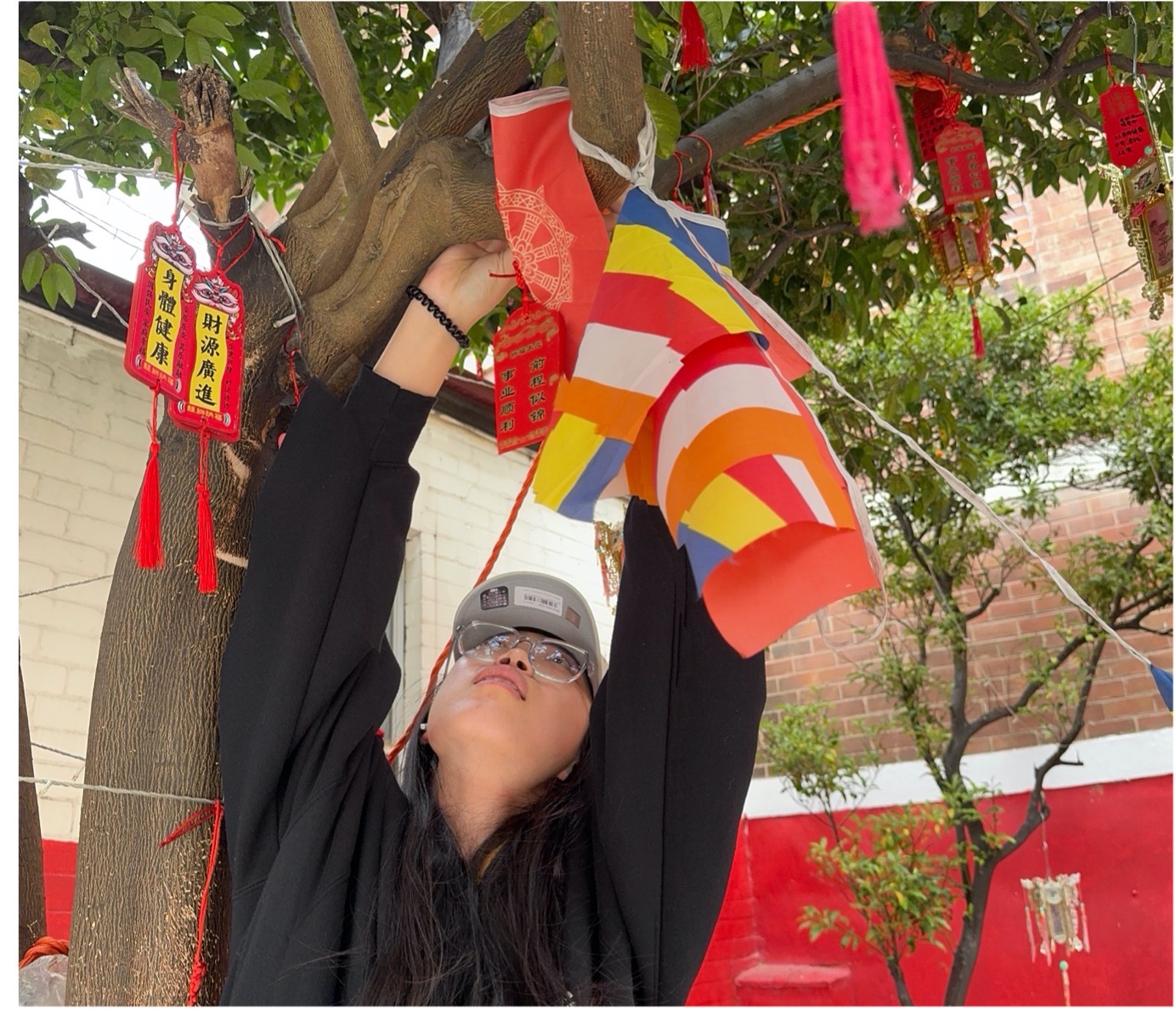
Placing her wish among prayer flags and talismans on a wishing tree in the courtyard of Yiu Ming Temple. Photo: Shilei Wang
I walked to the back of the courtyard, where the communal kitchen felt like a quiet fragment of time preserved. On the long red table, small cloths in pale green, grey-white, and light yellow were carefully folded and placed before a red plastic stool.
On the metal shelves, rice cookers of different sizes sat side by side, and stacks of white porcelain bowls were arranged. Their shapes and patterns did not match, yet they stood in careful order, as if they had come from many old households and been gathered under one shared roof.
Above my head, red lanterns and pompom-shaped paper decorations hung from the ceiling, as if reused year after year. Nothing in the room was put perfectly, but everything had found its spot.
I observe their daily life, which resembles a rural welfare kitchen in southern China, practical, old-fashioned, and maintained by routine and care. In this room, the old folk cook, eat, occasionally argue, then chuckle.
I also met a volunteer. He told me that he was the first person they turned to for minor troubles in the elderly people’s lives, such as fixing electrical appliances and sorting out clothes. He took on these small requests one by one and handled them quietly.
It is precisely the simple work that maintains the genuine, down-to-earth warmth of this small group, brought together by loneliness. He was like an invisible glue, filling the gaps left by time and distance.
The setting sun cast a golden glow over the green glazed tiles of the Yiu Ming Temple. Staff member Han Dongcheng, having finished his final inspection for the day, prepared to close the gates. The hum of traffic outside continued, but inside the temple’s walls, time slowed once more, settling into a profound tranquillity.
The smoke wreathed upward around the beam, following the fire’s scar and blending into the twilight. It stood silent witness to a hundred years of longing, struggle, and rebirth.
Standing against the evolving Sydney skyline, the Yiu Ming Temple remains a stubborn relic of the past. For every soul seeking a moment of peace in its walls, it remains a haven after a long voyage across the sea of time. I also made a wish of my own, just a ten-dollar wish. Half was for my future path, and the other half was for the elders’ peace. Ashes to ashes, dust to dust, but community and faith rise again, from the fire.