
On October 13, 2025, the Nobel Prize Committee announced it would award the Sveriges Riksbank Prize in Economic Sciences jointly to Joel Mokyr, Phillippe Aghion, and Peter Howitt.
The prize was awarded to the three parties “for having explained innovation-driven economic growth” in a two-part manner.
Joel Mokyr is credited with “having identified the prerequisites for sustained growth through technological progress”. Aghion and Howitt were awarded their half “for the theory of sustained growth through creative destruction”.
This is to say, in the most oversimplified of terms, two things:
- Innovation makes the economy grow quicker
and
2. This can be good for some people, and bad for others.
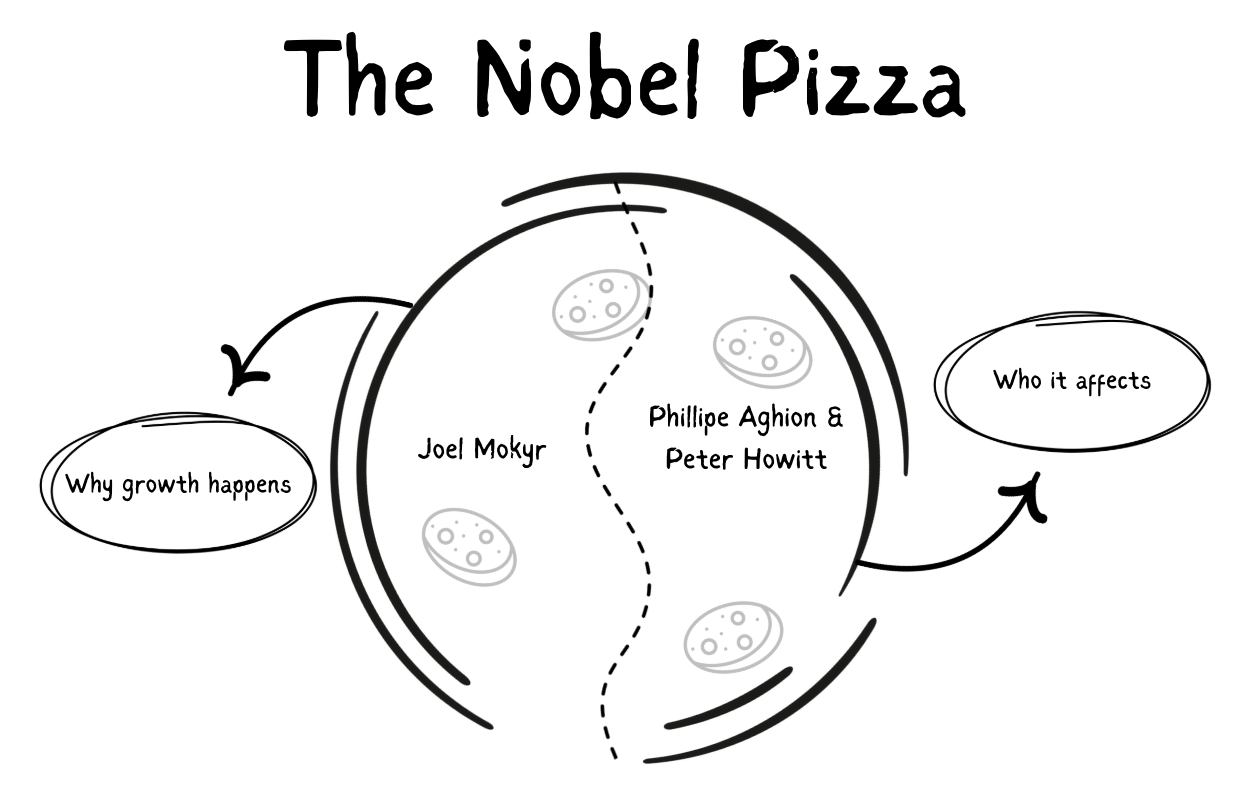
Everyone wants a piece of the pie… especially when it comes to one of the highest honours in academia. Here’s my simple (yet delicious) analogy to explain it.
But maybe let’s go through that in a bit more detail…
Mokyr’s Economic History
Joel Mokyr is an Economic Historian, a rare breed of economist who looks back in time to understand how past economies developed and/or failed.
The research in question interrogated why the world began to experience significantly greater and sustained economic growth after the industrial revolution in the eighteenth century.
During the industrial revolution, economic growth increased to 2 per cent per annum. Economists speculate that this is almost ten times previous growth rates.
He attributes it to a ‘culture of knowledge’, where innovative improvements and efficiency developments became more intentional. As societies began to embrace scientific progress, one-off inventions evolved into a step towards a better invention. Just as a typewriter was a step towards a computer, or a horse drawn carriage precede a motor vehicle.
Let’s look at that through a more palatable lens.
A Piece-zza History
Imagine that there are two Italian restaurants on your street: La Familia, owned by a local family, and Viva L’Italia, a new installment by a larger chain.
La Familia has a very special tomato sauce that is served on their pizzas. It is top secret, made by the family’s Nonna, and follows no strict procedures. Nonna has refined the art of picking her tomatoes, how many times to stir the pot, and which herbs should be added when.
It’s perfect, and tastes like Italy itself. But, the recipe will die with her. The innovation will not go any further.
Viva L’Italia has a recipe used across chains, that has been designed by food scientists, and trialed by numerous chefs. It is improved by everyone who picks up the wooden spoon, and will outlive each of its creators. One restaurant may afford organic vegetables, or have an extra spice to throw in. The chef at your local restaurant may have learnt a special chopping technique in culinary school, or has their own secret ingredient.
Italian food is the way to my heart… am I making you hungry?
Perhaps Viva L’Italia has a less authentic tomato sauce. But, it has been developed and innovated in a continuous fashion over time. The recipe is never a finished product.
I hope your mouth is watering… But what does all of this have to do with the industrial revolution?
Joel Mokyr’s argument is, in essence, that economies are more successful when the products within it are constantly changing. That’s why Viva L’Italia can continue to expand its chain – because the innovation that makes it special doesn’t just belong to one person.
But is that a good thing? I, for one, much prefer a family-run restaurant for my Italian nights.
That’s where Phillipe Aghion and Peter Howitt come in!
Aghion & Howitt’s Creative Destruction
In this portion of research, the awardees note that economies have a tendency to grow in short bursts, and then stall. This begs the questions, how do economies have endless capability to grow, even as old industries die?
The answer is ‘Creative Destruction’.
This cycle recognises the winners and losers of economic development, in the way that new innovations make old products obsolete.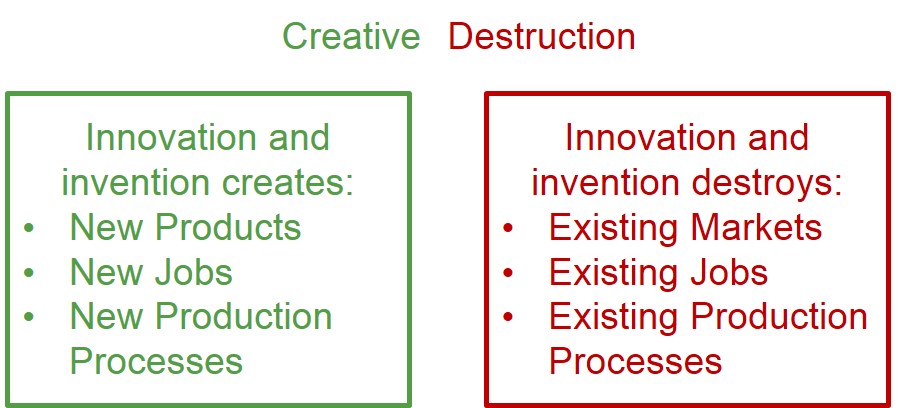
What goes up, must come down… or something like that…
Endless examples spring to mind: smart phones killed flip phones, digital cameras overtook film, and TV squashed radio…
Make no mistake: there are losers. And they aren’t always the one that you are rooting for.
Under Mokyr’s model, Viva L’Italia, are the better innovators. La Familia, while they have a certain charm and authenticity, have a less effective business model in the long-run.
They are not able to increase their scale of production, and self-improve as technology allows them to.
Development and change is to be encouraged as they are integral to making the product sustainable and continually relevant. They are able to outlive one good invention, and turn it into another.
That’s why ‘trade secrets’ really are of value, and why big companies with aged wisdom are able to maintain stronghold monopolies and oligopolies.
So, in the world of your street, pizza and the Nobel Prize for Economics, the little guy loses.
Is that a good thing? I’m not so sure.
But that’s show biz baby.