The Australia Western Sahara Association (AWSA) hosted a special screening of “Limbo: The Forgotten Promise” at NSW Parliament House on 17 September 2025.
Hosted by the Hon Janelle Anne Saffin MP and Ms Kobi Lee Shetty MP, the screening focused on Western Sahara’s long-running struggle for self-determination.
The Hon Cameron Murphy AM MLC, Member of the Legislative Council, delivered an opening remark on behalf of Janelle Saffin, who was unable to attend.
Cameron framed Western Sahara as “often described as the last colony in Africa,” and being “routinely ignored as land has been seised by neighbours.”
“I’m very proud, in the Labor Party, having worked with people like Janelle over the last 30 years, to ensure our party platforms are absolutely clear and consistent in support of Western Sahara and its self-determination,” Cameron said.
Introducing the film, Ms Kobi Shetty MP described “Limbo: The Forgotten Promise” as an initiative that seeks “to break the prevailing silence around Western Sahara and the Sahrawi people.”
She also thanked A, “for always keeping this issue front and centre.”
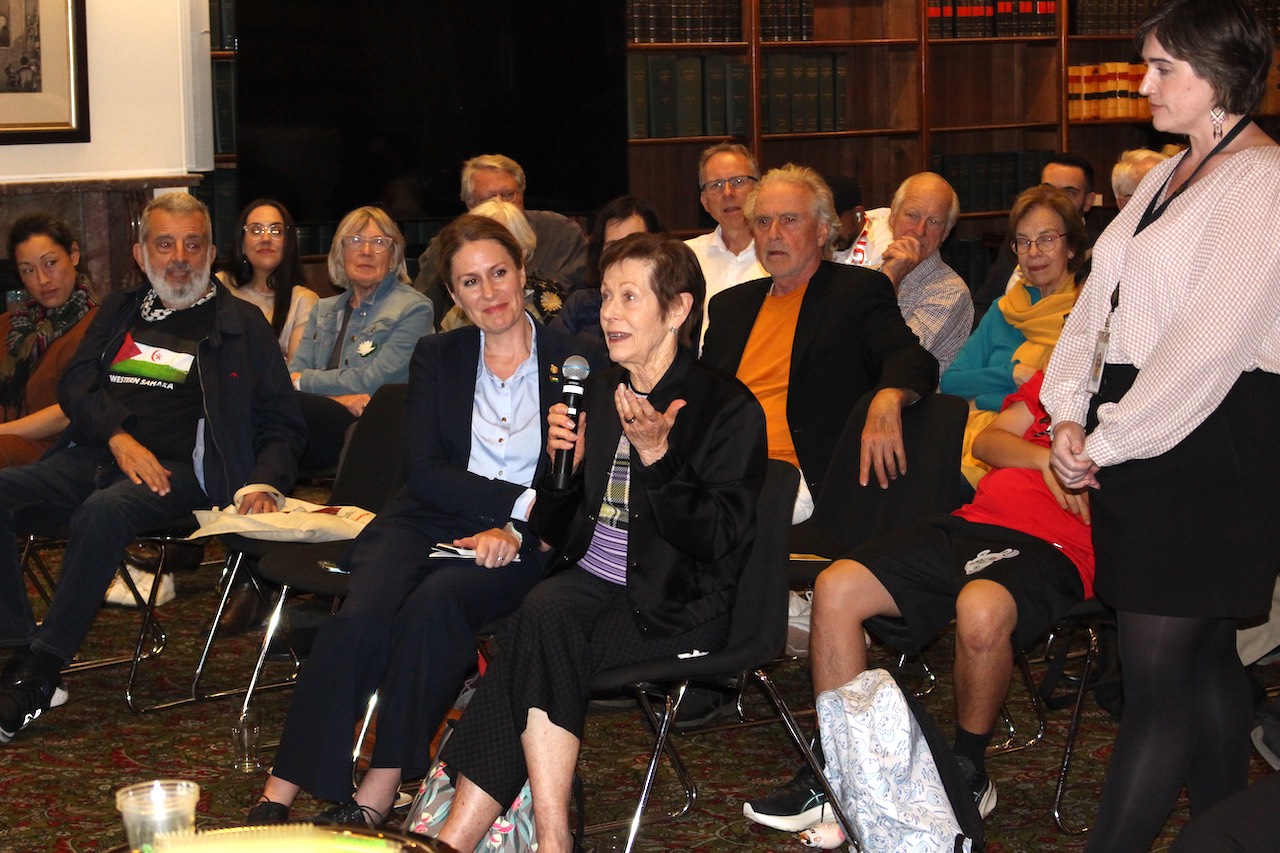
Lesley Osborne, Secretary of AWS
Limbo – The Forgotten Promise (2020) is a 50-minute Spanish documentary by Antonio Rodrigo. It shows the Sahrawi people’s struggle across generations.
The film mixes personal stories about oppression and resistance with calm scenes of desert life and culture. The main idea is a broken promise: a UN-backed vote on self-determination that never happened. Because of this, the Sahrawi people are stuck in a political “limbo.” Western Sahara is the largest territory still on the UN list of non-self-governing areas. After Spain left in 1975, Morocco moved in and took control. The Polisario Front declared the Sahrawi Arab Democratic Republic and fought a war until a 1991 ceasefire. That ceasefire included a plan for a referendum on independence, but it has been delayed ever since.
The film also shows family and community across time. It avoids big speeches and polarisations. Resistance looks like patience, organisation, school, care work, and small celebrations. Self-determination is delayed, but the most powerful moments are simple: a shared meal, a joke, a look toward the horizon.
Notably, this film is less about events in the past and more about the long wait. International issues are lived day by day by real communities with their own songs, schools, worries, and humour. As a view into Sahrawi life, it is generous; as a push to learn and care more.
The screening was followed by discussion and Q&A, with Mr Kamal Fadel, Representative of Frente POLISARIO in Australia and the South Pacific, and Dr Randi Irwin, Lecturer in Anthropology and Program Convenor for the Master of Social Change & Development at the University of Newcastle.
Fadel referenced longstanding UN processes and the International Court of Justice’s 1975 advisory opinion, warning that allowing occupation to stand “sets a dangerous precedent” for other conflicts.
He said a durable resolution “must return the last word to the people concerned through a free and fair vote,” noting the importance—but current limitations—of UN engagement, including humanitarian support coordinated with United Nations High Commissioner for Refugees (UNHCR).
Dr Randi Irwin highlighted a different perspective: large-scale renewables (green hydrogen/ammonia; solar and wind) planned in the territory.
While not “extractive” in the classic sense, she warned that massive land transfers and grid integration could link Western Sahara economically and legally to Morocco.
Irwin noted that some Australian firms are involved at the level of speculative investment in green-energy pilots.
Building on the momentum of the Parliament screening and Q&A, AWSA and Green Left are convening a community forum and film night, “The Campaign to Free Western Sahara,” on Saturday 8 November at 5:00pm at the Resistance Centre, 22 Mountain St, Ultimo.
The program features Kamal Fadel and Dr Randi Irwin with two short documentaries—Western Sahara: “The worst police state I have ever seen” (conflict overview) and Unsubmissive (women in the occupied territories). Meals and low-cost drinks available; RSVP via the flyer’s QR code or contact Rach 0403 517 266.