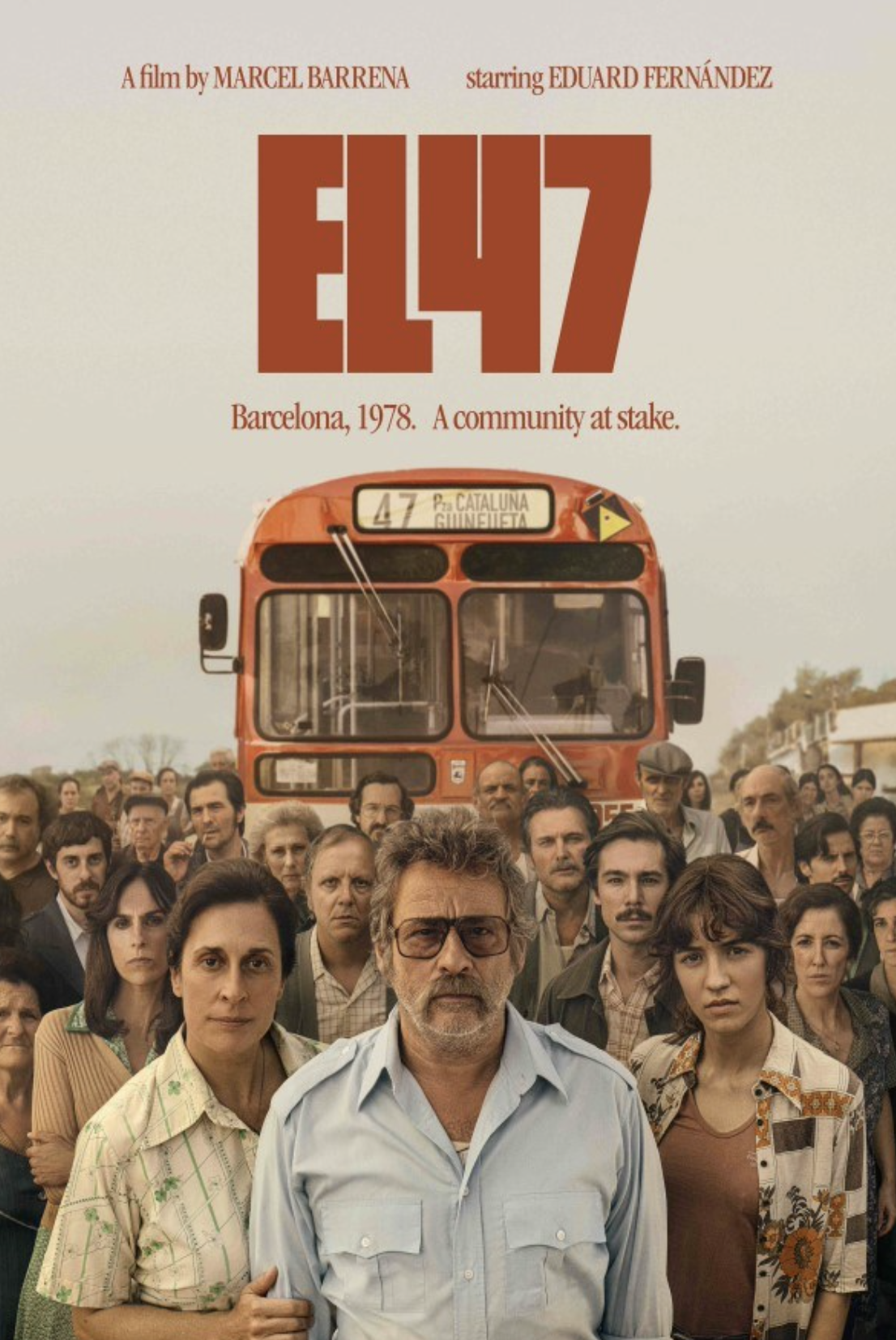
El 47, this year’s centrepiece at the Spanish Film Festival, is a poignant biopic that shines a light on a little-known piece of Spanish history in the aftermath of Franco’s dictatorship.
Inspired by a true story, Marcel Barrena’s film follows the injustices faced by Torre Baró, a self-built shanty neighbourhood on the outskirts of Barcelona. During the 1950’s, the rise of the repressive political party Falange Española forced many dissenters and their families to abandon their homes in Spain’s south and establish new communities in the north. Barcelona experienced an influx of these immigrant workers, but as the film poignantly shows, the city’s government was far from welcoming.
The opening scenes of El 47 establish the contrast between Torre Baró and broader Barcelona. Torre Baró is shot using a muted colour palette that exemplifies its anachronistic quality. Chickens and donkeys meander down the narrow streets, which are unpaved and dusty. Children are shoeless and take classes in a makeshift shed. Women fill buckets from a well, the sweat visible on the foreheads as they struggle with the hand pump under the sun. When the year appears on the screen in big numbers – “1978” – the audience are jolted, lost in a momentary confusion.
The scene cuts to the bright and sleekly high-tech metropolitan Barcelona. Barrena combines new cinematography with old footage to takes us convincingly back in time to the 70’s. Motorbikes criss-cross through multilane traffic. Ladies are dressed in bold shoulder pads, funky prints and stilettos. Men wear suits and talk on mobile phones as they cruise through glamorous business districts. One scene shows a group of children enjoying a summer day in a city park. They splash each other with water that flows effortlessly from a large brass tap. While Torre Baró is a mere stone’s throw away from this city bustle, Barrena’s clever imagery makes it seem like a different world.
Taking us between these two contrasting worlds is Torre Baró local Manolo Vital, played by the magnetic Eduard Fernández. Based on the real-life man, Manolo was among the first inhabitants of the neighbourhood. He fled from his home with daughter Juana (Zoe Bonaforte) in Andalusia due to his leftist ideology. Since arriving twenty years ago, Manolo has established himself as one of the city’s best-loved bus drivers. Regular commuters adore his good humour and chatty disposition. He has a rare gift to draw people together from all walks of life. On his bus – El 47 – a young PhD student can banter with an abuelo about last night’s football game and an upper-class Catalan señora can make conversation with factory workers about the weather.
It is this gift that makes Manolo such a powerful force in his own community. As the unofficial neighbourhood leader, Manolo is passionate about seeking equality for Torre Baró and providing its children with the opportunities their parents never had. His maxim, “Use your head!”, shapes his approach to dissent. He is methodical and patient, placing his trust in Barcelona’s bureaucratic systems to get the justice his people deserve. “Dignity is not an abstract thing”, he tells the council’s town planner, “it is running water, electricity and public transport.”
Fernàndez is captivating on screen. He crafts Manolo’s character is an authentic way, achieving a balance between his grandiose leadership and passion for community, and also his vulnerability and weariness. Afterall, he’s been fighting this same fight for 20 years.
The chemistry he builds with Clara Segura, who plays Manolo’s wife Carmen, is also exceptional. Manolo and Carmen share a deep love that gives each a source of sustenance that sees them through their more challenging days. When Manolo is informed that the city’s council has rejected his proposal for a bus to connect the isolated Torre Baró with other areas of Barcelona, it is Carmen who propels him back into action.
Finally realising that using his head alone won’t make change in the rigid government system of Barcelona, Manolo takes matters into his own hands and hijacks the El 47 bus. These moments are shot with an almost tangible energy. The audience are completely mesmerized by the neighbourhood’s resistance. “They told me, ‘Who’d want to get a bus up that hill?”, Manolo shouts to a cheering crowd. “I said, ‘The people who walked down here this morning!”
El 47 is an uplifting film that reminds us that we can really achieve more when we work together. With authentically crafted characters and a powerful true-story plot, it is certainly a must-see at this year’s festival.
El 47 is screening at Sydney Palace Cinemas until July 16.